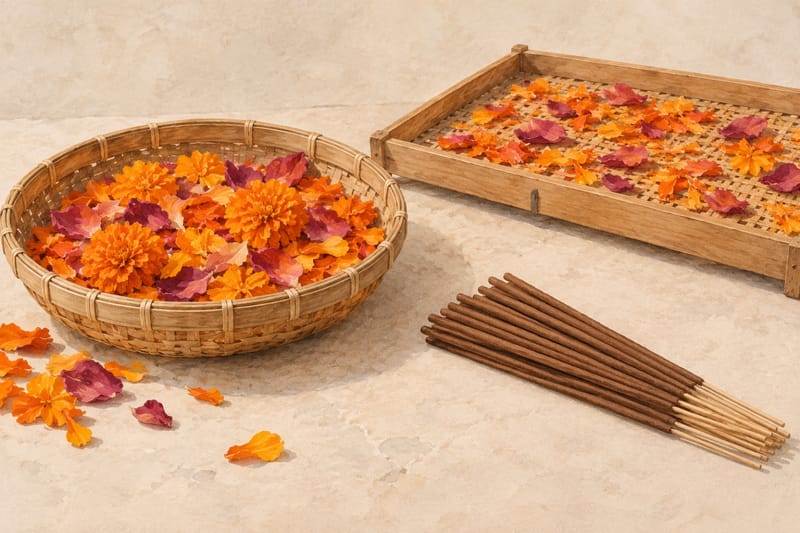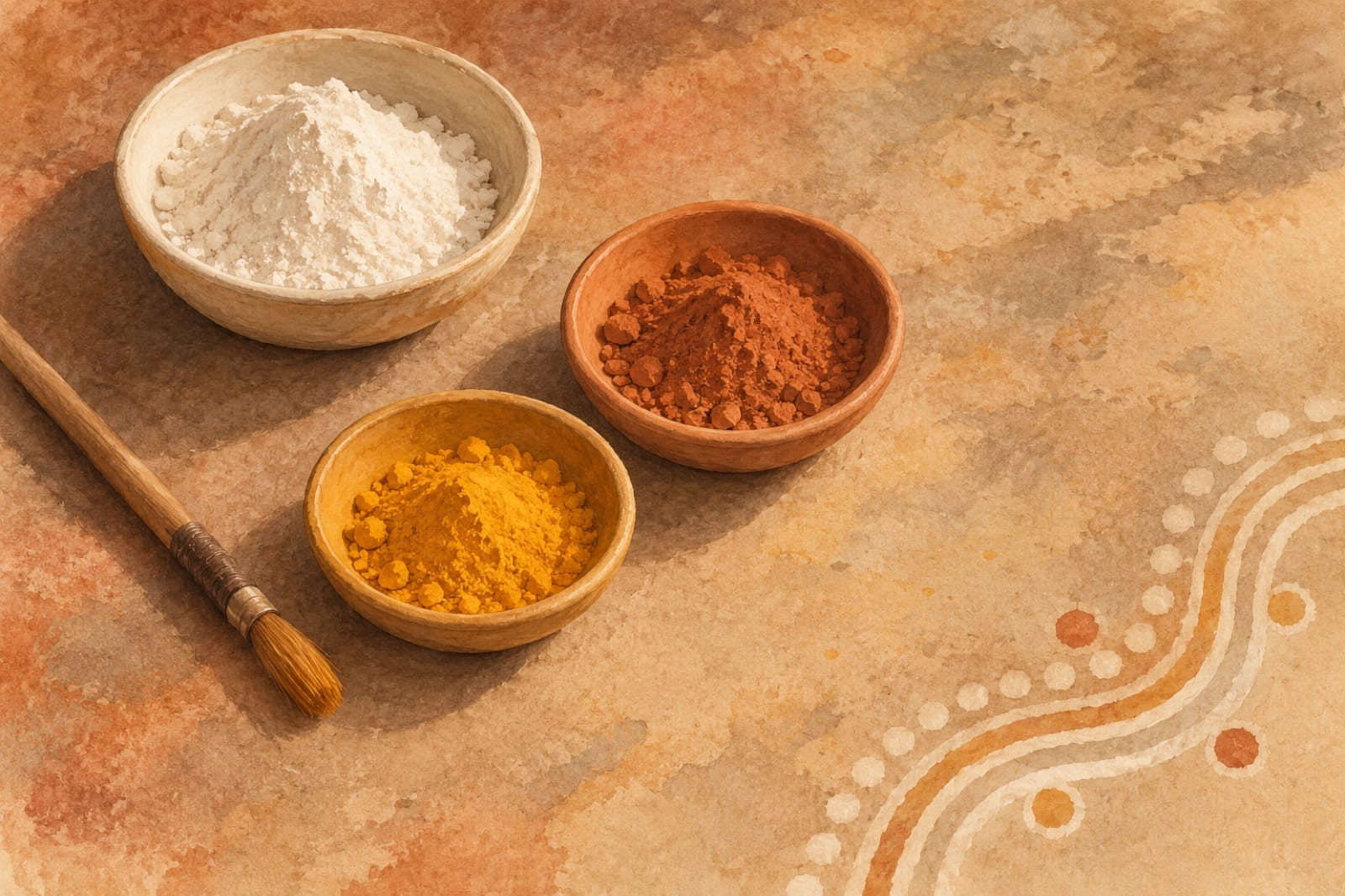
Ayodhya's folk-art traditions offer a different place to begin looking at the city's culture: ordinary materials and family occasions. The district administration describes rice and wheat flour, turmeric, kumkum, vermilion and kajal used as colours, with a ground prepared using mud and cow dung.
Its culture and heritage account connects folk expression with festivals, rituals and life events. This is an undated description of a tradition, not a survey showing how often households practise it today.
A palette close to everyday life
The materials are an invitation to think about art beyond a purchased paint set. Flour and turmeric have roles in a home before they become part of a visual expression. Their appearance in the district's account places the artistic act close to the materials of daily life.
Start by noticing the surface as well as the colour. A drawing on prepared ground has a different setting from a framed painting. Where is it placed? Who will see it? Is it part of a family occasion, a ritual or a decorative display? Those questions give the work a context that a close-cropped photograph may leave out.
Familiar creatures and plants become motifs
The district account lists symbolic depictions of elephants, horses, peacocks, parrots, mangoes and guavas, alongside village and family deities. It associates such depictions with weddings, births and other rituals.
These are recognisable forms, but recognition does not settle their meaning. A parrot in one composition need not have the same role in another. Ask the person who made the work what belongs to the occasion and what is their own choice. Avoid turning a list of motifs into a fixed dictionary of symbols.
Pay attention to repetition and placement while you look. Notice which form sits at the centre, which marks create a border and how empty space helps separate the parts. These are ways to examine a work, not instructions for copying a particular ritual design.
The occasion belongs in the picture
For wider regional context, Ajay Jaitly and Saptami Pal's 2023 paper on Uttar Pradesh's Chowk Purna describes ceremonial designs made for auspicious occasions. Its abstract includes flour, turmeric and ground-rice slurry among the materials and relates the designs to ritual purpose.
The paper's scope is Uttar Pradesh. It helps explain a regional context; it does not establish that every Ayodhya drawing has that name, follows the same design, or is made by the same kind of practitioner. The district's own account supplies the local connection.
That distinction matters when sharing an image. A short caption identifying the maker, occasion and place, with their permission, can be more informative than labelling everything simply as traditional art.
Let a maker explain their work
If a relative or host invites you to see a design, make room for their explanation before photographing it. Ask whether recording or sharing is welcome, and respect a private ceremony's boundaries. An invitation to a celebration does not automatically make every part of it available for a styled shoot.
You can learn without asking someone to perform a tradition for you. Ask what they want you to notice, which materials they chose and who taught them, if they are comfortable discussing it. Do not turn one person's account into a claim about all families in Ayodhya.
The pleasure lies in seeing how an occasion becomes visible. A familiar material, a repeated line and a maker's explanation can give you a more personal encounter with culture than a label alone.
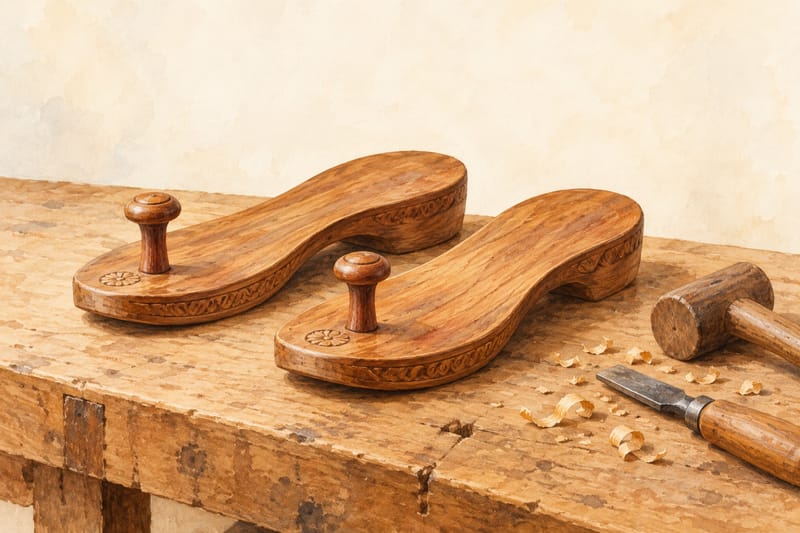
For a distinct form of handwork, read the documented making process behind Ayodhya's wooden khadau.
Sources checked on 11 October 2026. The district account is undated and the research paper is from January 2023. This article does not report a household visit, establish current prevalence, or prescribe a ritual design.
AI-generated editorial illustration of flour, turmeric and earth-coloured materials with an abstract border. Conceptual artwork, not a reproduction of an Ayodhya ritual design or a photograph of a household ceremony. Resized for display.