A flower offered in worship can have another use after it leaves the shrine. In Ayodhya, INTACH's local chapter describes an initiative called MAHAK that turns temple floral material into incense. Its story connects devotion with a practical skill: making something from what remains after an offering.
The chapter's MAHAK project account describes training women near Guptar Ghat with expertise from Lucknow. The page is undated, so it documents the initiative rather than establishing its present scale or what is available to buy today.
From an offering to a useful material
The project's short description places incense-making at its centre. Flowers that have completed one purpose become material for another. This is a different way of looking at a city's devotional life: through the work associated with its offerings, as well as through its shrines.
A Hindustan report dated 15 December 2022 adds detail to that earlier period. It describes collecting offered marigold and rose flowers, drying them and carrying out further preparation to make incense. The report connects the work with INTACH, the Panchmukhi temple at Guptar Ghat and the Central Institute of Medicinal and Aromatic Plants in Lucknow.
That account gives the idea a local setting and a sequence. Collection is only the beginning; preparing the material and learning to make the product matter too. The report is historical evidence, not confirmation that its collection arrangements continue unchanged.
The skill behind the second use
The Government of India's Office of the Principal Scientific Adviser lists a CSIR-CIMAP process for flower-based incense sticks and fragrant cones, using flowers and leaves offered at places of worship. This establishes that the material has been the subject of a developed process. The national record does not establish which formulation a particular Ayodhya product uses.
For a reader interested in local enterprise, the useful question is how an idea becomes repeatable work. Someone must arrange collection, prepare the material, learn the process and find customers. A photograph of a finished packet tells only a small part of that story.
MAHAK's chapter account describes women's involvement and training. It does not provide a dated picture of current earnings, hours or production. Those would be valuable questions for a future reported conversation with the people involved, rather than gaps to fill with an imagined success story.
Read the promise carefully
Reusing flowers is an interesting material choice. It does not, by itself, tell you the ingredients of a finished incense product, the conditions in which it should be used, or the size of any environmental benefit. Treat those as separate questions requiring product information and evidence.
If you encounter a product associated with the initiative, ask who made it, what it contains and where its floral material came from. Check current availability directly instead of relying on an old article. This piece is an introduction to a documented local idea, not a shop recommendation or a review of a product we have tested.
A different detail to notice in Ayodhya
Places are also understood through the materials people work with. Following the afterlife of an offering draws attention to preparation and skill that are easy to overlook in a temple photograph.
If this story makes you curious about the area where the chapter describes the work, read our introduction to Guptar Ghat. A riverfront visit and a workshop visit are different things; ordinary visitor access does not mean a project is open for demonstrations.
Sources checked on 11 October 2026. The chapter account is undated and the local report is from December 2022; current operations, product availability and measured outcomes have not been independently verified.
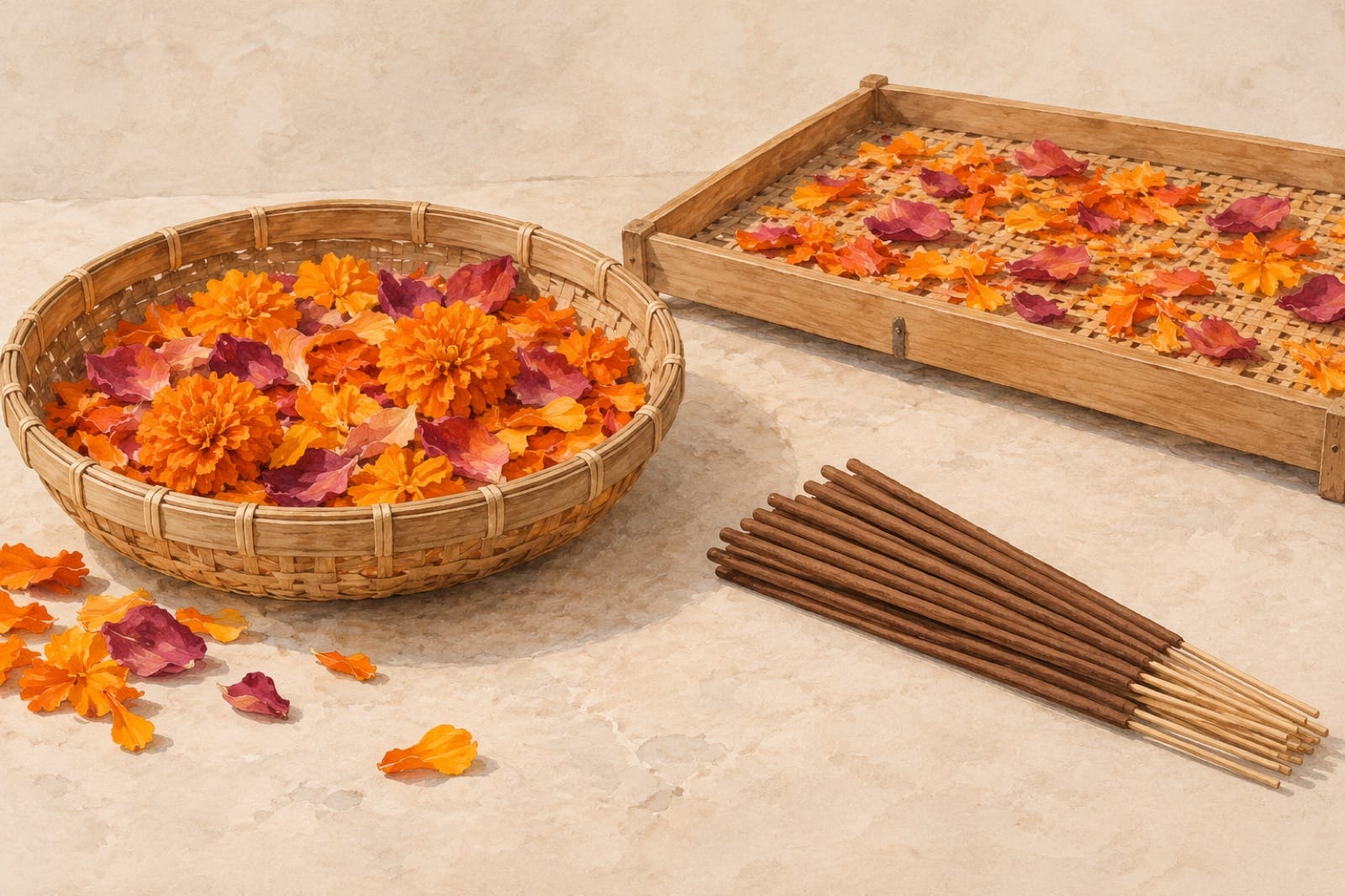
AI-generated editorial illustration of flower petals, a drying tray and unlit incense sticks. Conceptual artwork, not a photograph of MAHAK products or an Ayodhya workshop. Resized for display.