Gulab Bari means Garden of Roses. At its centre stands the tomb of Nawab Shuja-ud-Daula, the third Nawab of Awadh. The combination gives this place its character: a royal memorial set within a carefully arranged garden, with water channels leading the eye towards the building. The Ayodhya district administration describes the setting.
If you enjoy discovering a city through its buildings, give Gulab Bari a place on your Ayodhya list. In the Faizabad part of the district, it offers a way into the region's Nawabi history through things you can look at closely: the garden's layout, repeated arches and the outline of the dome.
The ruler remembered here
Shuja-ud-Daula belonged to the eighteenth-century history of Awadh, also written as Oudh. The Lucknow district administration's account of the Nawabs places much of his life in Faizabad and identifies Gulab Bari as his mausoleum.
The Ministry of Tourism records that he commissioned the tomb during his lifetime. That detail changes how you might approach the building. A ruler was shaping the place in which he would be remembered, with the garden forming part of the setting.
You do not need to memorise a succession of rulers to appreciate it. Knowing whose memorial you are visiting gives the architecture a human subject.
Read the garden before the building
The tomb sits in a charbagh garden with fountains and shallow water channels. Start by looking at the arrangement as a whole. Notice the relationship between the open ground and the building at its centre, then follow the lines that connect them.
It is an enjoyable way to look at architecture without specialist vocabulary. Where does your eye go first? Which features repeat? How does the view change when you move from the approach towards the tomb?
The district's guide describes roses beside the water features. Flowering and maintenance conditions can change, so let the garden's design be part of the attraction whatever is in bloom when you visit.
Look for the arches and the detail above them
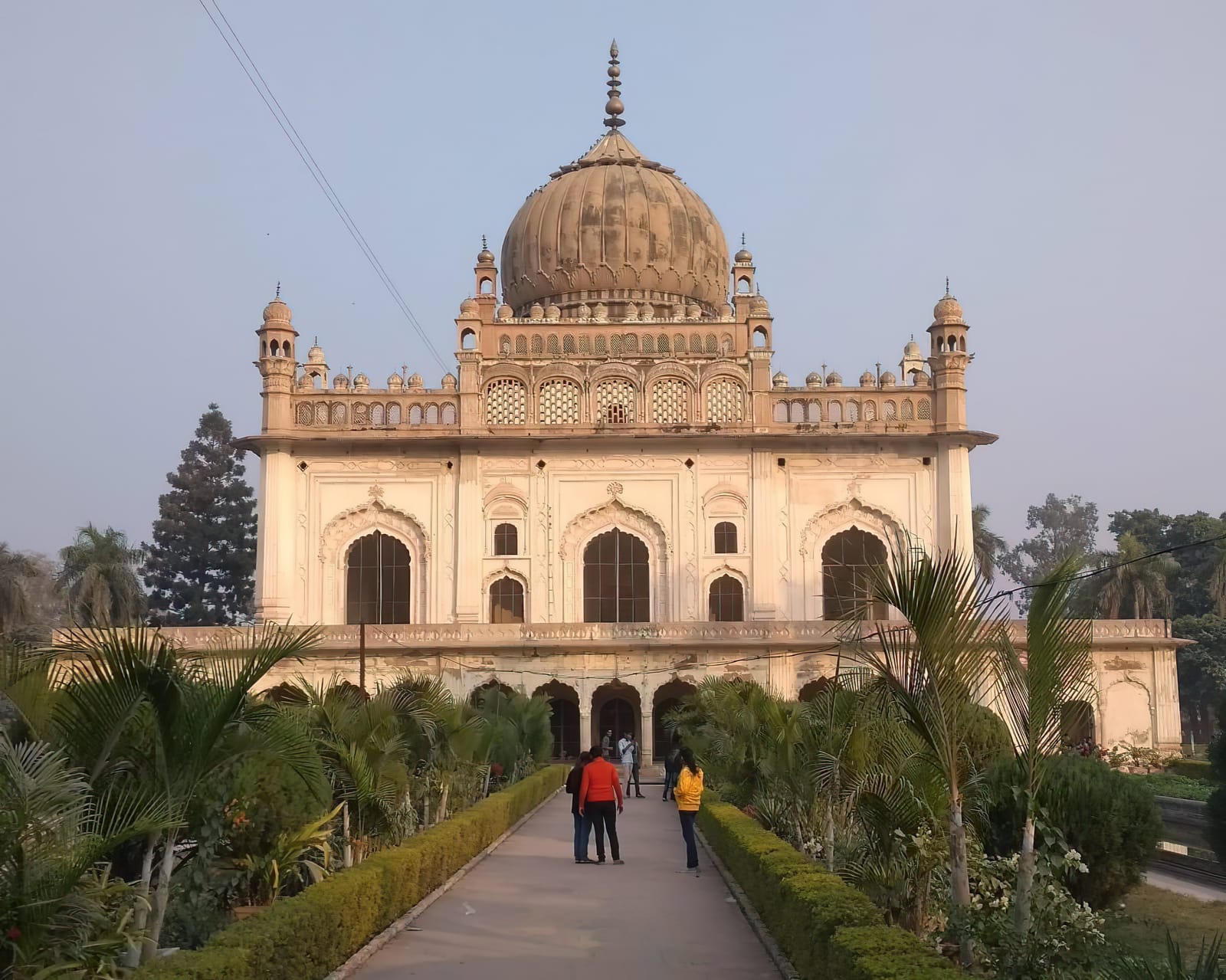
The official tourism description identifies a square, two-storeyed mausoleum with arched verandahs. Above them, a three-arched façade and small minarets at the corners give the upper level its rhythm. The central dome is topped by an inverted-lotus feature and a metal finial.
Look at the overall outline first, then choose one detail to follow. You might trace the repeated curves of the arches or notice how the smaller vertical elements frame the dome. A second look often reveals something that disappears in a quick photograph of the whole building.
The same official account describes the surrounding enclosure as lime-plastered Lakhauri brick with decorative plaster mouldings. These details reward attention at ground level as much as the dome does from a distance.
Make room for a respectful visit
Gulab Bari is also a place of religious significance. Move through it with the care you would bring to any memorial or place of worship, following current instructions about entry and photography.
For a first visit, check the exact location in Faizabad, current opening arrangements and which parts of the complex are accessible. Confirm any applicable entry or photography charges directly. Opening hours copied between travel pages should not determine an important journey without a fresh check.
Wear comfortable footwear and plan for the weather. If someone in your group needs step-free access, ask about the actual approach and visitor route before setting out. A heritage listing alone does not establish accessibility.
Take time to see the garden and building together. Gulab Bari adds a specific chapter to an Ayodhya visit: the memory of an Awadh ruler, expressed through the proportions of a tomb and the space around it.
If you are visiting with family for a celebration, our ideas for exploring Ayodhya between wedding functions offer other ways to spend free time together.
Official sources checked on 30 September 2026. Confirm current visitor arrangements before travelling.
Gulab Bari, photographed on 23 December 2018. Photo: Prajjwal3959 / Wikimedia Commons, CC BY-SA 4.0. Resized for display; the layout may crop the image. The photograph and any adaptation remain under the linked licence.