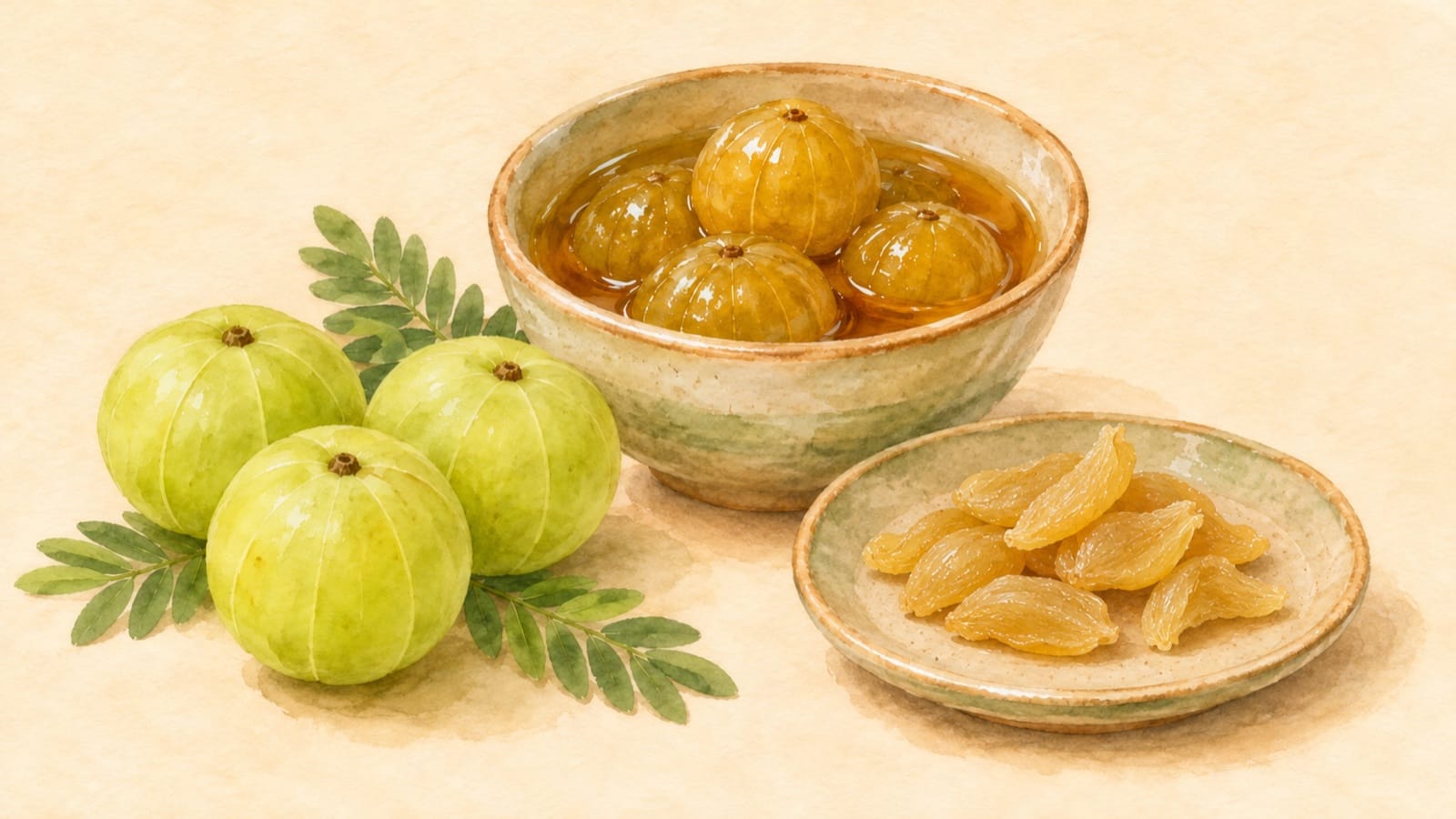
Aonla can arrive at the table in very different forms: a fruit sitting in syrup, a chewy candied piece or a savoury pickle. Following those changes offers a food story connected to Ayodhya through the work of its agricultural university in Kumarganj.
The connection is documented rather than a claim about a particular sweet shop. A university training manual and report records a course on processing aonla fruit held on 28–30 January 2020. Preserve and candy were among the practical preparations. The record opens a useful question for anyone curious about food: how does the same fruit become such different things to eat?
A small fruit, several directions
Aonla, also commonly called amla, has a sour, astringent character. The Kumarganj manual treats processing as a way to make a range of products from it, including sweet preparations, pickle and drinks. That range matters more here than a claim that one preparation is the correct local form.
Imagine arranging a tasting around the fruit rather than around a list of shops. You could begin by asking what form each preparation takes. Is the fruit whole or divided? Does syrup surround it, or can you pick up a separate piece? What has the maker chosen to emphasise?
These are observation questions, not a test with one approved answer. They make room for different recipes and preferences without turning a food into a competition.
What makes a preserve different from candy?
Tamil Nadu Agricultural University's amla processing guide describes a preserve as fruit, or pieces of fruit, impregnated with heavy sugar syrup until tender and transparent. Its guidance explains why preparation before syrup matters: cooking the fruit directly in syrup can cause shrinking and reduce sugar absorption.
For candy, the guide includes drying after the syrup stage. That gives you a simple distinction to look for: a preserve remains a syrup-based preparation, while candied pieces have a drying stage. The university guide is a technical explanation, not proof that every jar or packet sold follows its exact method.
At the table, pay attention to the difference between the surrounding syrup and the fruit itself. With a candied piece, notice the surface and the resistance as you bite. A comparison can be interesting even when you prefer one form immediately.
The Kumarganj connection
The 2020 course was organised by the College of Horticulture and Forestry at A.N.D. University of Agriculture and Technology in Kumarganj, Ayodhya. Its programme included hands-on work and evaluation of prepared products.
That is a specific local link: food-processing knowledge being taught and practised. It does not establish that the preparations originated in Ayodhya, that a present-day shop uses the university's methods, or that the course is currently open to visitors.
Knowing this changes the kind of question you might ask about a food souvenir. Alongside “Where was it bought?”, ask “Who made it?” and “What did they do with the fruit?” A place can have a relationship with food through learning and experimentation as well as through a famous market.
Bring curiosity to the jar
If you choose to buy a preparation, read its own ingredient and storage information and ask the seller about anything unclear. The processing notes explain a category of food; they cannot establish the contents, keeping quality or suitability of an individual product. This article is a tasting and food-culture guide, rather than a home-preservation recipe.
For a shared tasting, keep the original packaging or maker's information beside each item. Let people choose whether to try it, and compare impressions without promising a health benefit. The pleasure can be quite simple: recognising one fruit across several textures and flavours.
For another food comparison, explore sheermal and roomali roti, where the interest lies in what two breads bring to the table.
Sources checked on 4 November 2026. The Kumarganj training record dates to January 2020; no current shop, course availability or product shelf life was verified.
AI-generated illustration of fresh aonla, a syrup preserve and candied fruit. Not a photograph of a particular product, recipe or university activity. Resized and JPEG-compressed for display.