Ayodhya's riverfront has a visible side: steps, paths, buildings and people gathering beside the Saryu. It also depends on work that a visitor may never see. Wastewater has to be collected, carried and treated. Understanding that system adds another way to read a river city, beyond the appearance of its ghats.
Three kinds of record help tell this story: a plan for the river, a report of completed infrastructure and a dated operating entry. They answer different questions. Reading them together is more useful than treating any one announcement as a verdict on the whole river.
Start with the journey to a treatment plant
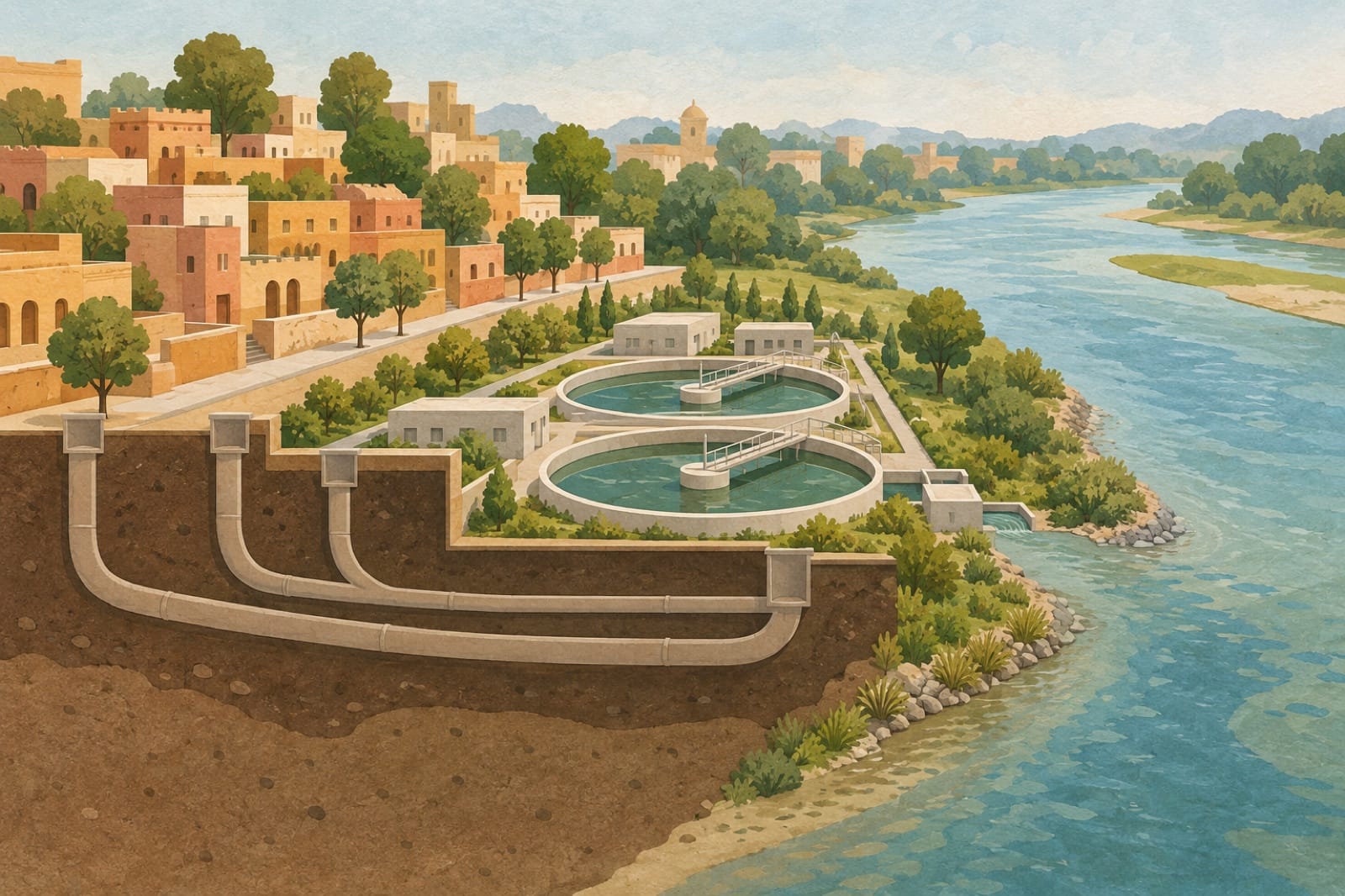
An STP is a sewage treatment plant. Collection matters as well as treatment: wastewater must reach the facility. The US Environmental Protection Agency's general explanation describes sewers carrying wastewater from homes, businesses and industry to treatment facilities before discharge or reuse. That explains the basic relationship; it is not a description of every pipe in Ayodhya or a statement of Indian regulatory requirements.
When a project mentions both a plant and an interception-and-diversion network, pay attention to both parts. Ask what has been built to collect the wastewater, as well as where it is treated. A photograph of a tank tells only part of that story.
A documented project beside the Saryu
In an 11 April 2025 release, India's Ministry of Jal Shakti reported an Ayodhya sewage-treatment plant with a capacity of 33 MLD, together with an interception-and-diversion network. It gave the project cost as ₹222 crore and included it among completed sewerage projects.
MLD means million litres per day. The capacity figure describes the scale of the facility; it should not be read as a claim that exactly that amount is treated every day. The release is evidence of the ministry's reported completion, not a current inspection by this publication.
Capacity and use are different numbers
The Uttar Pradesh government's existing-STP table gives the Ayodhya 33 MLD entry a utilisation figure of 23.50 MLD. Its row is marked as last updated on 15 June 2026.
The date belongs with the number. This is a dated portal entry, not a live flow meter or today's reading. The table alone does not explain the difference between capacity and utilisation. It would be misleading to turn that gap into an assumed fault, a claim about spare capacity for a particular neighbourhood or a guaranteed daily operating level.
For a reader, the useful habit is simple: find the unit, find the date and check what the column actually measures before drawing a conclusion.
The river plan looks beyond a single plant
The National Institute of Urban Affairs' summary of Ayodhya's 2023 Urban River Management Plan places wastewater within a wider picture. It identifies waste disposal, riverbank development, natural buffers and biodiversity alongside sewage-related challenges.
The summary describes proposed responses including local wastewater treatment, better solid-waste management and restoration of vegetation along riverbanks. These are planning measures, not proof that every proposed intervention has been delivered.
This wider view matters because a riverfront is more than a paved edge. Water, land, plants, infrastructure and everyday use belong in the same discussion. The plan gives readers a framework for asking how those parts are being considered together.
Look beyond the finished view
On your next riverfront visit, enjoy the setting while remembering the less visible work behind it. In project reports, look for the collection network, the treatment facility, dated operating evidence and what remains proposed.
None of the records discussed here establishes current bathing or drinking-water safety at a particular ghat. They are different kinds of evidence from a location-specific water-quality assessment. This article supplies no water-contact recommendation or plant-visit arrangement.
For another view of the river landscape, explore our article on Ayodhya's wetland birds and the habitats beyond open water.
Sources checked on 1 November 2026. Project reports, dated operating entries and proposed plans are kept distinct; no current river-water safety assessment is supplied.
AI-generated conceptual illustration of a town, pipes, treatment basins and a river. Not a photograph, engineering diagram or representation of Ayodhya’s actual treatment-plant layout. Resized and JPEG-compressed for display.