A wetland is more than the open water in the middle. Its shallow margins, patches of plants, resting places and neighbouring fields can offer birds different ways to use the same landscape. Looking at those edges gives you something more interesting to follow than a distant flock alone.
In Ayodhya district, a field study by Yashmita-Ulman and Manoj Singh provides a local starting point. Their 2022 paper in the Journal of Threatened Taxa reports surveys from March 2019 to February 2020. Nine wetlands were selected initially; six were retained for analysis, including Samda Jheel. These are dated observations, not a guide to what is present today.
Look where water meets land
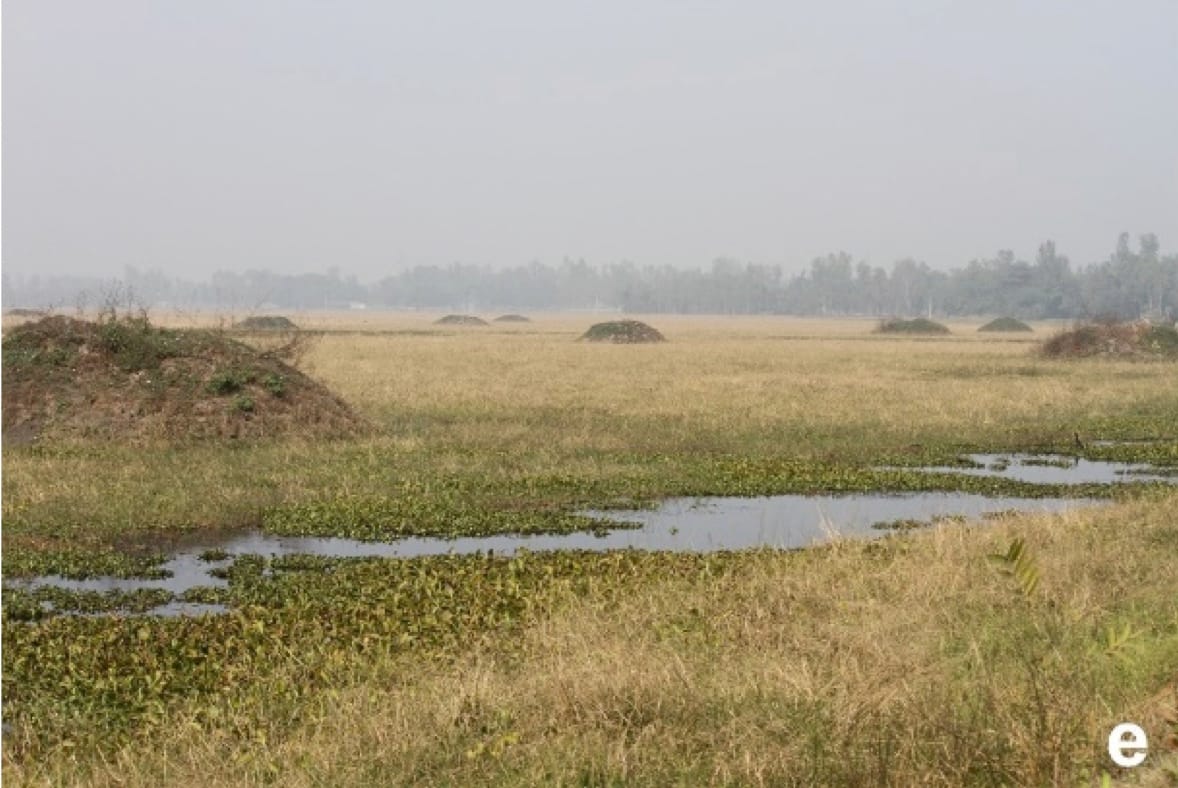
The researchers described Sirsa and Samda Jheel as having shallow water and marshy areas, with fields and trees around them. At Samda, they recorded artificial mounds provided by the Forest Department as resting places for waterbirds.
That description changes what you might notice in a wetland photograph. A small raised patch is no longer just an interruption in the water. A line of plants is more than a green border. Ask where a bird could stand, where it could feed and where it could rest.
Those questions are a way of looking, not a claim that every patch has the same function. Water depth, vegetation and the birds using a place need observation. A broad expanse of water and a shallow margin should not be treated as interchangeable scenery.
Two birds, two ways into the landscape
The study’s checklist records Sarus Crane as resident and Northern Pintail as a winter visitor. Both were recorded at Samda during the research period.
The Cornell Lab’s Sarus Crane guide describes a tall grey crane with pink legs and red skin extending from the head down the neck, typically wading in shallow wetlands or cropped agricultural areas. Its habitat description is a reason to look beyond the water’s centre and consider the neighbouring ground too.
For the pintail, notice a different relationship with the water. Audubon’s species guide describes feeding in shallow water by tipping forward, tail upwards, or lowering the head and neck while swimming. It also describes winter and migration habitat that includes shallow waters and exposed mudflats. This is general species context, not a report of feeding behaviour observed by us in Ayodhya.
You do not need to turn a first look into a confident identification. Start with what you can describe: standing or swimming, near vegetation or in open water, feeding or resting. Use a reliable guide to check a name rather than attaching one to every distant shape.
Keep the season in the story
Across the study, the researchers recorded their highest monthly species richness in January and February. That historical pattern helps explain why a wetland can look different at different times of year; it does not guarantee a particular bird on a future winter visit.
If you keep notes, include the date and the part of the habitat you were watching. “Birds beside the plants” is a different observation from “birds on open water”. Returning to that distinction can make a short period of watching rewarding even when you cannot name every species.
Watch without rearranging the scene
The American Birding Association’s code calls for minimising habitat disturbance, caution near nests and feeding areas, and restraint when approaching or attracting birds. It also says not to enter private property without permission. These are general birding principles, not local access instructions.
Choose a permitted, safe observation point. Let the birds set the distance: a closer photograph is not a reason to enter vegetation, approach a nest or disturb a resting group. Check current arrangements with the responsible local authority or landholder before planning an outing. This article does not verify public entry, paths, opening hours, boats or resort operations at the research sites.
For another part of Ayodhya’s living landscape, explore the Saryu through a dolphin survey. Here, keep your attention on the wetland’s edges: the interest lies in how water, land, plants and birds meet.
Primary study and birding sources checked on 27 October 2026. Local records refer to 2019–20; no current sighting, conservation-category assessment or visitor facility is claimed.
Samda Jheel, Image 1e in Yashmita-Ulman and Manoj Singh’s 2022 study, Journal of Threatened Taxa. Exact photograph date not stated. Photo: © Yashmita-Ulman & Manoj Singh, 2022 / published plate, CC BY 4.0. Panel extracted from the plate and JPEG-compressed; not a current-condition photograph.