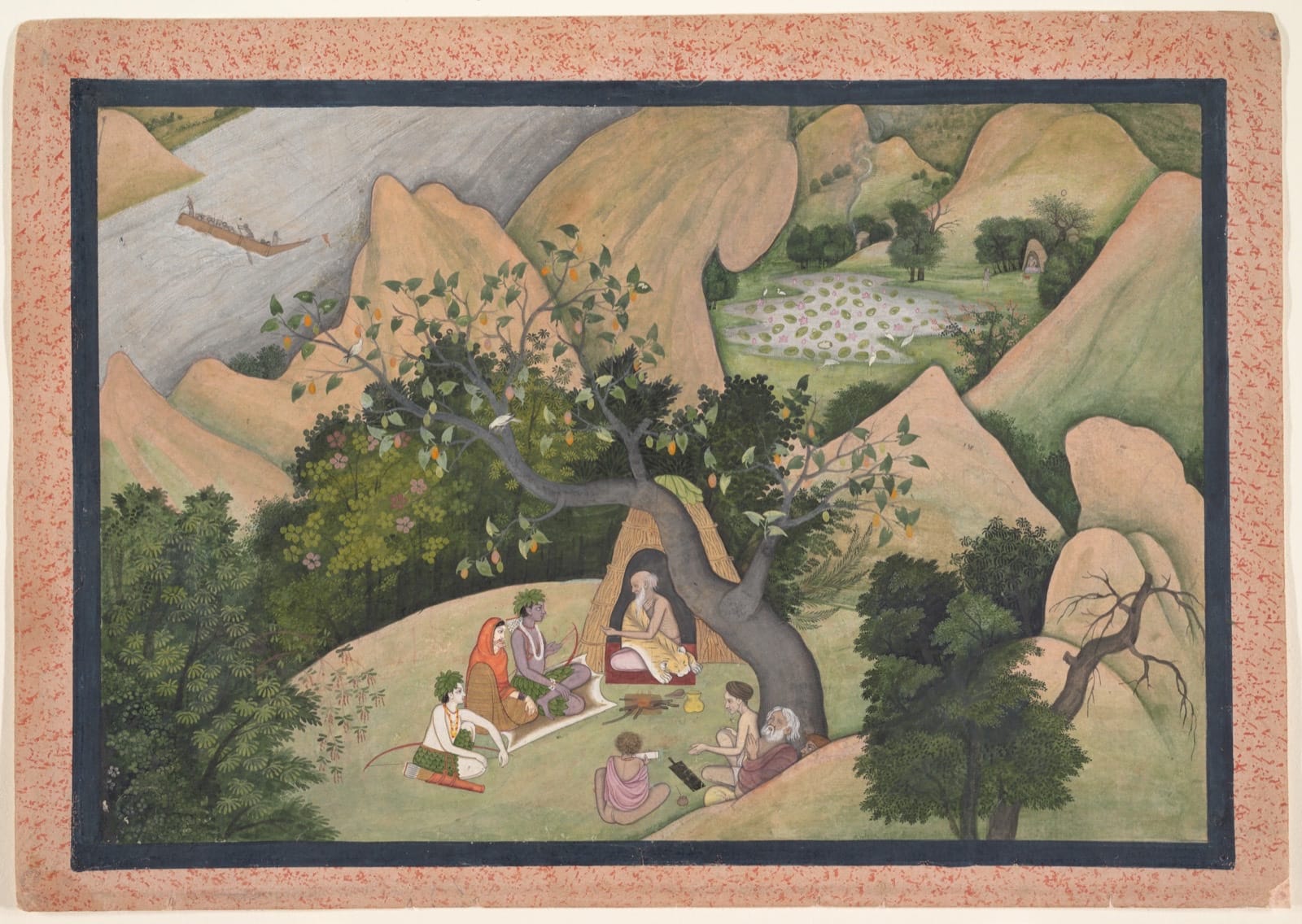
A boat crosses a river near the upper left of the painting. Lower down, three travellers sit before a hermit beneath a broad tree. Mountains rise beyond the forest. These details invite you to read a journey across the page, rather than look for a single frozen instant.
The picture is Rama, Sita, and Lakshmana at the Hermitage of Bharadvaja, held by The Metropolitan Museum of Art. Its collection record places the work in Kangra, Himachal Pradesh, around 1780. It offers a way to explore the Ramayana through the organisation of a painted landscape.
Find the crossing, then the conversation
Begin with the small ferry. It occupies only a little of the picture, surrounded by a wide, pale stretch of water. Then look towards the much larger seated figures in the foreground. The change in scale asks you to adjust your attention: a distant movement gives way to an encounter you can examine closely.
The Met identifies the travellers as Rama, Sita and Lakshmana, arriving at Bharadvaja’s forest hermitage during their exile. It explains that the hermit directs them towards shelter in the Chitrakuta Mountains, shown at the upper right.
Try following those parts in that order: crossing, meeting, distant destination. Then reverse your route. The painted space remains the same, but the story becomes easier to notice once you have somewhere to begin.
How can one picture hold several moments?
A painting does not need separate boxes to suggest events unfolding over time. Figures and settings can carry the reader between episodes within one continuous space. The Met discusses continuous narrative in the Ramayana series to which this folio belongs.
A second collection example makes the device explicit. In Rama Releases the Demon Spies Shuka and Sarana, attributed to Manaku and dated around 1725, the museum identifies three events arranged in one composition. Its account follows the spies being brought before Rama, entering a palace and reporting to Ravana.
You need not identify every figure unaided. Start with a museum’s explanation, then return to the image and ask where the action changes. A repeated character can mark a later moment rather than another person. Space becomes a way of organising time.
Let the landscape slow your looking
Return to the Bharadvaja painting and look between the main episodes. Notice the clusters of leaves, the curving banks and the tree spreading over the hut. The foreground meeting occupies a clearing; the water and hills offer other kinds of space.
Choose one small feature and follow it with your eye. How do the riverbanks guide you? What happens where the open water meets the dense trees? Which part feels nearest? These are prompts for looking, not claims about the painter’s documented intentions.
The border matters too. Keep the whole reproduction in view before enlarging a detail. Looking only at the seated group would lose the crossing and the distant setting that help the narrative unfold.
A story landscape, not a visitor map
This is a painted Ramayana scene. Its river, forest and mountains should not be used to identify a present-day route through Ayodhya or reconstruct the physical setting of the epic. The date around 1780 belongs to the artwork, not the events of the narrative.
For another encounter with the story through a surviving object, read about Ayodhya’s 1792 Ramayana manuscript. A manuscript and a painted folio preserve different forms of attention: one invites questions about a particular copy, the other about how a story takes visual shape.
Museum records and image rights checked on 26 October 2026. The observations above concern the historical artwork, not current visitor arrangements or documentary geography.
Rama, Sita, and Lakshmana at the Hermitage of Bharadvaja, ca. 1780, Kangra, Himachal Pradesh. The Metropolitan Museum of Art, Seymour and Rogers Funds, 1976, 1976.15. Museum image and record; public domain / CC0. Resized and JPEG-compressed; full composition retained.