Ayodhya has a food story that begins before the sweet-shop counter. Jaggery—often called gur—is the district’s selected product under Uttar Pradesh’s One District One Product programme. Following it takes you towards sugarcane and the work of turning juice into something you can hold, break and use in a kitchen.
The ODOP district page identifies Ayodhya with jaggery products. That gives a visitor a specific local product to ask about. A useful conversation starts with where a batch was made and who made it, rather than assuming that everything sold in the city was produced in the district.
The journey starts with sugarcane juice
The National Institute of Food Technology Entrepreneurship and Management’s jaggery-processing guide sets out the main sequence: crush the cane, filter the juice, clarify and boil it, then cool and mould the concentrated material.
Each stage changes what the maker is working with. Crushing releases juice from the cane. Filtration removes coarse material, while clarification prepares the juice for the next stage. Heating concentrates it; cooling and moulding give the finished gur its form.
That short sequence is a useful way to understand the product without treating a technical guide as a recipe for your own stove. It also gives you better questions to ask a producer. What form do they make? How do they pack it? Which parts of the process use equipment, and which require hands-on judgement?
A local industry with more than one way of working
The Ayodhya ODOP page presents jaggery as part of the district’s traditional rural industry. Its Common Facility Centre listing also identifies the Ayodhya Dham Jaggery Association and automatic jaggery-processing support.
Those two descriptions give the story room to develop. A traditional product can be made with contemporary equipment. When you talk to a seller or maker, ask about the actual batch and production method rather than deciding in advance what a local food ought to look like.
The centre listing describes industrial support. It does not establish a visitor experience or a factory tour. If you want to learn directly from a producer, arrange permission through their own current contact details before travelling to a working site.
Look beyond the word “local”
A seller can help connect a product to its maker, but only if you ask a clear question. “Was this made in Ayodhya district?” is more useful than “Is this local?” Follow it with the producer’s name, place of production and the information available on the pack.
If a batch comes from elsewhere, you can still make an informed choice. The point is to know what you are buying. The district’s association with jaggery is a reason to explore its producers; it does not establish the origin or quality of every piece of gur on a shop counter.
For a gift, tell the seller how long the journey will be and ask for suitable sealed packaging and the producer’s storage instructions. Keep any label or receipt with it. A small note naming the maker and place of production can give the recipient a more personal connection to the food.
Give the ingredient a place in your own kitchen
Think about how you intend to use the gur before choosing a quantity. Ask the seller which form suits that purpose, and whether the producer provides preparation or storage guidance. Start with an amount you expect to use rather than buying a large pack because it seems like a better souvenir.
When you get home, pay attention to the product itself: how it breaks, what its aroma suggests and how it behaves in the dish you have chosen. Those observations belong to your particular purchase. They are a more interesting starting point than repeating a broad claim that every batch must taste the same.
For another part of the city’s food culture, explore Ayodhya through three sweets. Jaggery adds a different question to that journey: what can an ingredient tell you about the work and people behind a place’s food?
Official product and processing sources checked on 9 October 2026. Producer visits, individual products, prices and availability have not been verified.
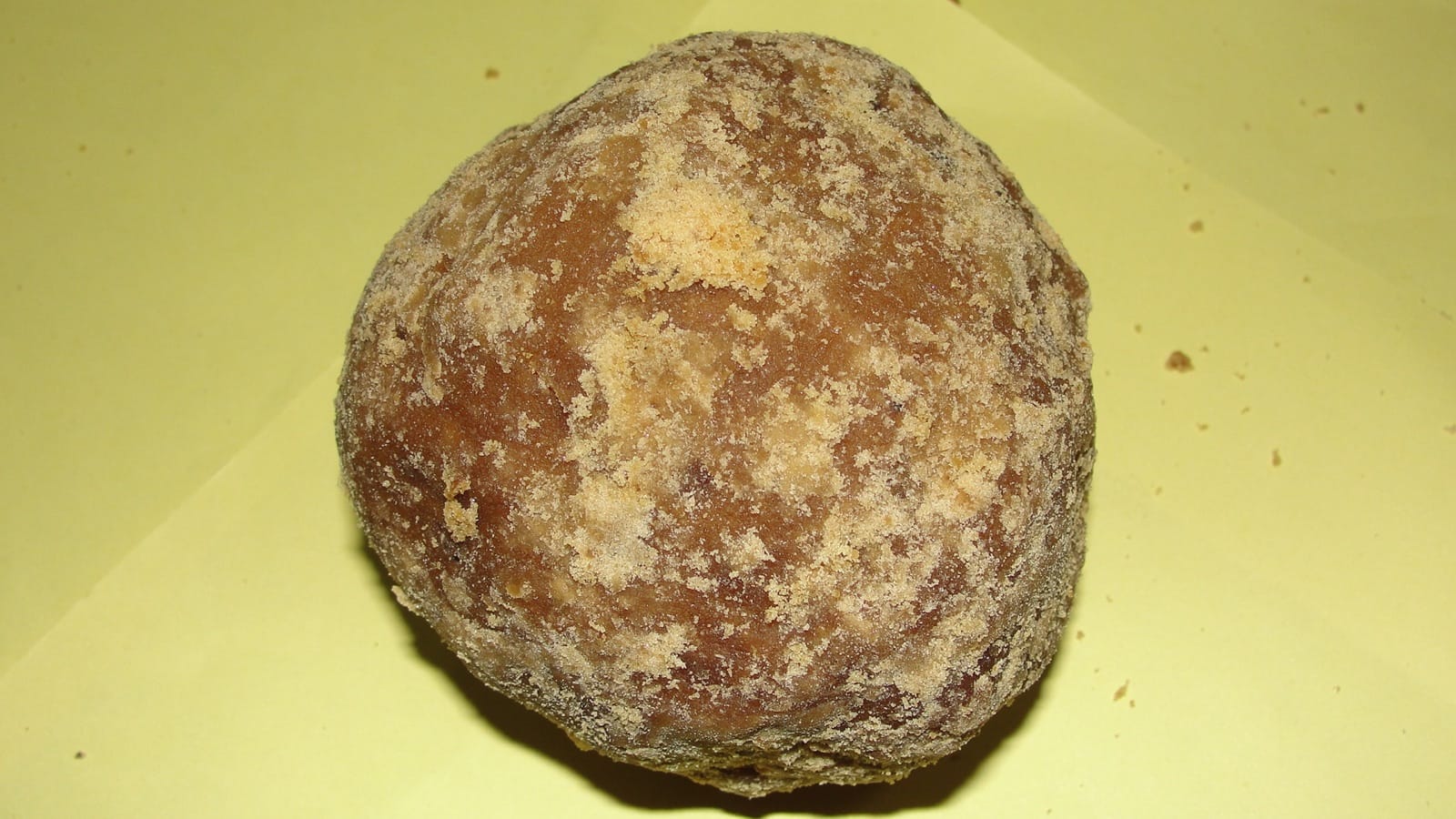
Illustrative jaggery photograph, taken on 2 January 2012; not verified as an Ayodhya product. “A Jaggery” by Thamizhpparithi Maari / Wikimedia Commons, CC BY-SA 3.0. Resized and compressed for display; the photograph and any adaptation remain under the linked licence.