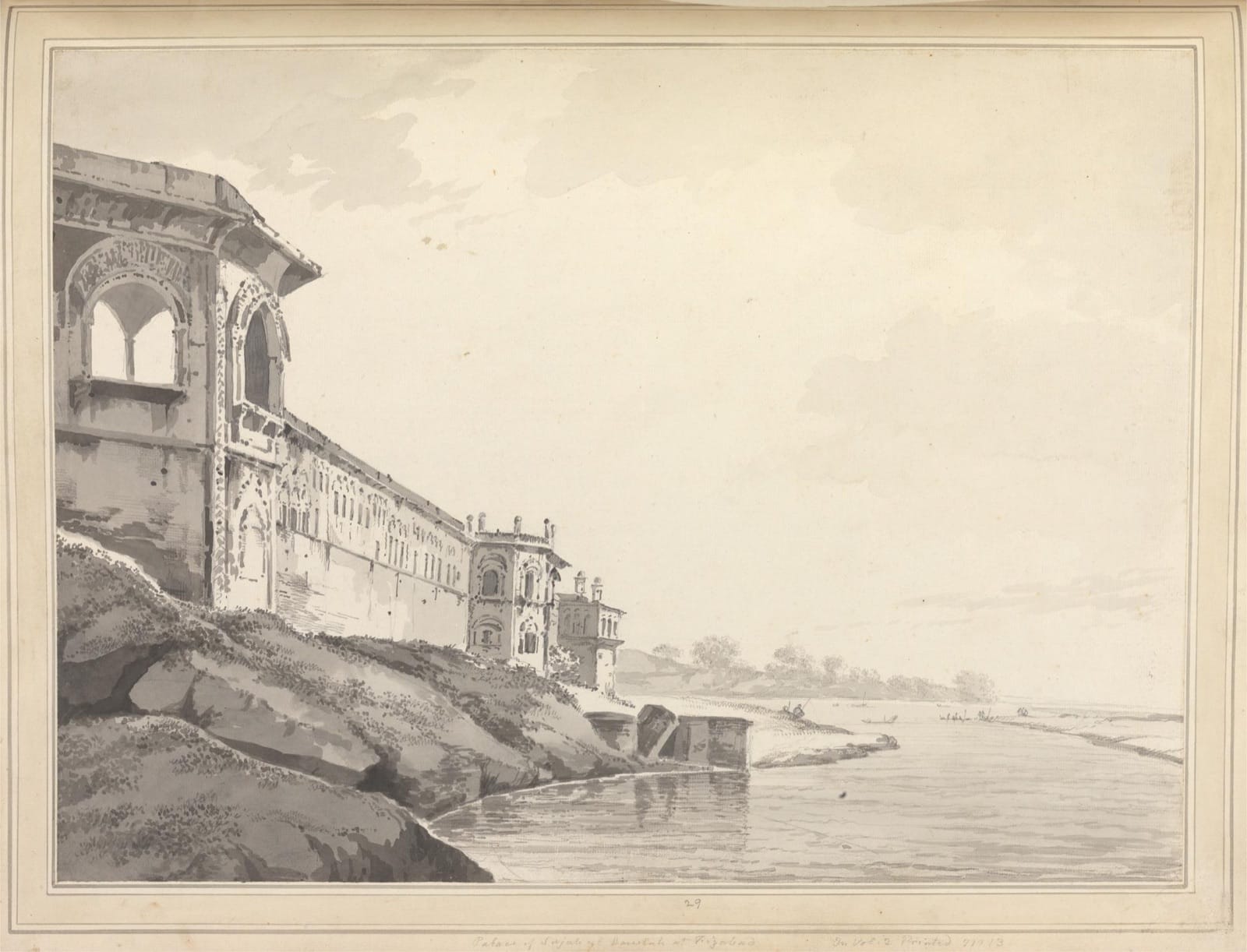
A palace occupies the left side of the drawing. Beyond it, a river opens into a much quieter stretch of paper. Small figures and boats sit near the water, easy to miss if you look only at the building. William Hodges’ view of Faizabad invites a second look at a city’s past—and at the choices an artist makes when showing it.
The Yale Center for British Art identifies the work as a drawing of part of the palace of Shuja-ud-Daula at Faizabad, dated around 1783. It belongs to the Paul Mellon Collection, with accession number B1978.43.1750. This is a historical artwork, not a photograph or a guide to a surviving visitor route.
Follow the wall towards the river
Start with the large open arches at the left. Then let your eye move along the palace wall as it recedes towards the water. The repeated openings become smaller with distance; the building’s outline takes you into the picture.
The river creates another direction. Its lighter surface spreads across the lower right, balancing the heavier architecture and bank on the left. You can follow the palace towards the distance, or follow the water away from it. The drawing holds both movements in the same view.
Try covering one side of the image on your screen for a moment. With the palace hidden, the remaining scene feels more open. With the river hidden, the architecture becomes the main subject. That small experiment makes the relationship between building and landscape easier to notice.
A drawing made with tone
Yale records gray ink, gray wash and graphite on cream laid paper as the materials. The differences between pale sky, darker wall and shaded bank do much of the work. You do not need a bright colour palette to suggest depth or make a building stand out.
Look at the darkest marks first, then the places where the paper remains light. Shadows under an arch help you read an opening; darker strokes on the bank make the ground appear uneven. Across the sky and water, lighter treatment gives the scene room to breathe.
These are ways of looking at this reproduction, rather than claims about the weather or exact conditions Hodges encountered. A drawing can preserve an artist’s view of a place while still leaving questions about how that view was constructed.
Find the people before moving on
The figures near the river are much smaller than the palace. Pause over them and the boats. Their scale makes the building feel large, but their presence also interrupts a reading of the scene as architecture alone.
It is tempting to supply a complete story for such small marks. Resist that urge. This image does not establish who those people were, what they were discussing or how a particular day unfolded. You can notice how they contribute to the composition without inventing their lives.
From a local view to a book of India
Yale places the drawing among the original works for Hodges’ Select Views in India. The Metropolitan Museum of Art’s record of the published volume dates it to 1786–88 and lists two plates showing part of Shuja-ud-Daula’s palace at “Fizabad”. The book’s illustrations used etching, aquatint and engraving.
The spelling can look unfamiliar today. In this context, “Fizabad” refers to Faizabad, rather than the separately listed “Firozabad” elsewhere in the same volume. A small distinction in a catalogue matters when following a place through old images.
A view selected for a book is also a view selected for an audience. Ask what receives attention here and what stays beyond the frame. A British artist’s landscape is one way of seeing Faizabad; it cannot stand in for every resident’s experience of the city.
Keep the artwork and the place distinct
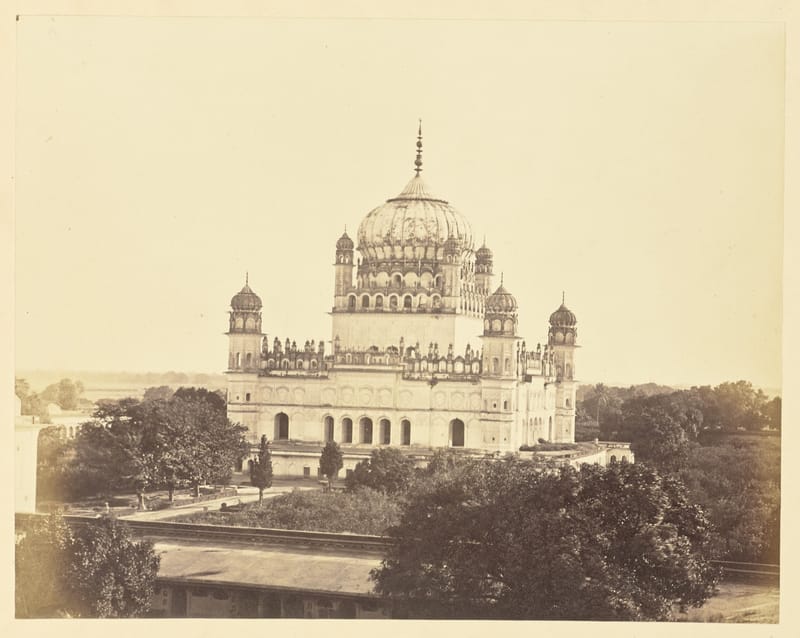
For a different encounter with the same Nawabi history, read about Gulab Bari, Shuja-ud-Daula’s mausoleum. The memorial and the palace drawing are different subjects. One should not be used to identify the other’s architecture.
Return to the drawing after reading its catalogue entry. The palace, river and small human figures may now hold your attention in a different order. That is part of the pleasure of looking closely: an old image gives you a specific view, while a careful second look reveals how much there is still to ask.
Museum records and image rights checked on 9 October 2026. This article discusses a historical drawing; it makes no claim about current access to the depicted palace.
William Hodges, view of Shuja-ud-Daula’s palace at Faizabad, around 1783. Yale Center for British Art, Paul Mellon Collection, B1978.43.1750. Museum record; Public domain / Yale open access. Reproduction via Wikimedia Commons; resized and compressed for display, without changing the scene.