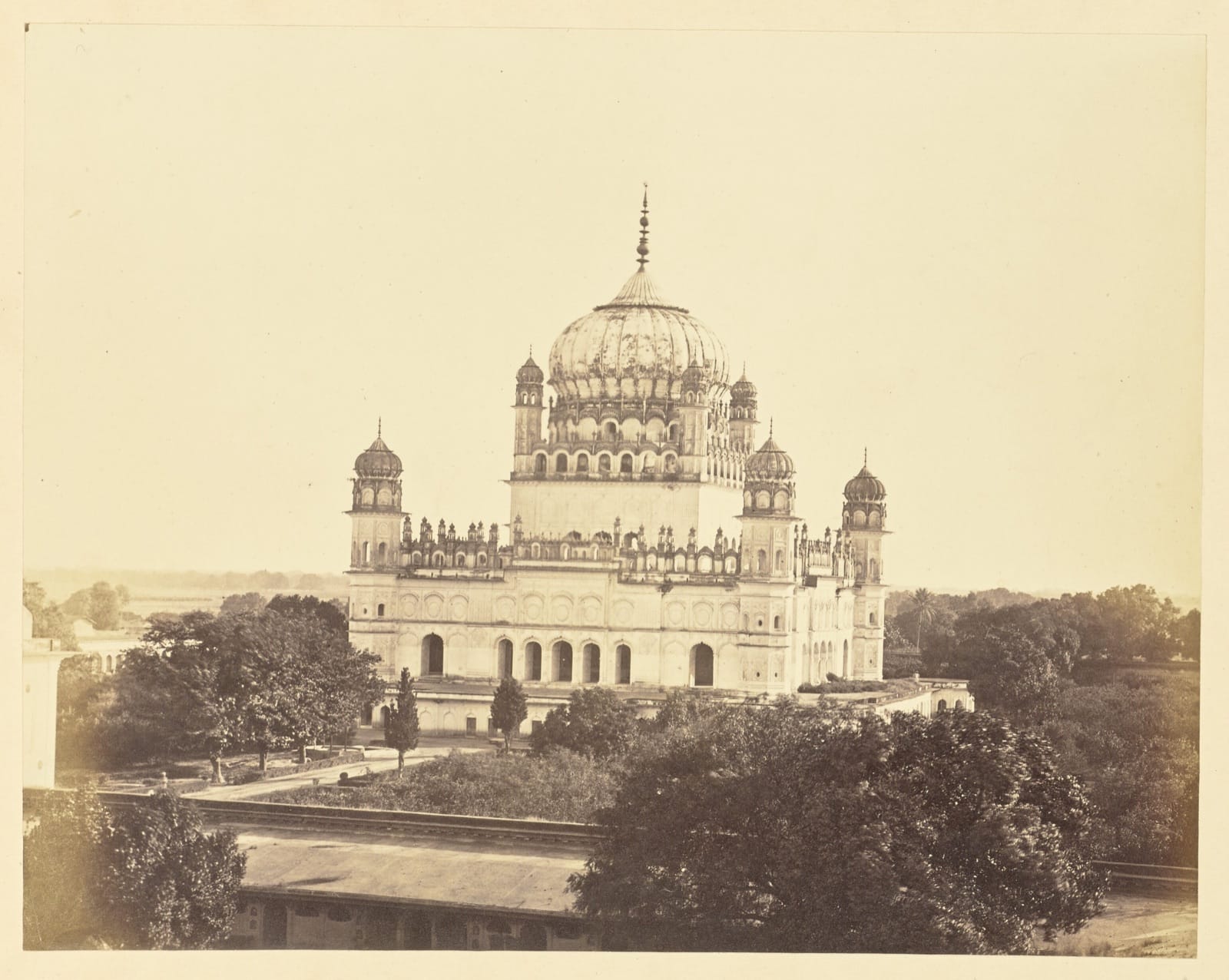
A pale nineteenth-century photograph offers a different way into Ayodhya's history. Trees and garden paths surround a mausoleum; above them rises a large dome, framed by smaller pavilions. The image invites you to look slowly at Bahu Begum's Maqbara before rushing to a present-day travel description.
The J. Paul Getty Museum's catalogue identifies the subject as the mausoleum of Bahu Begum in Faizabad. It dates the albumen silver print to about 1863–1887 and lists the maker as unknown. That uncertainty matters: this is a historical view with a date range, not a photograph we can confidently assign to a particular year or photographer.
Start with the building's outline
Look first at the relationship between the square base and the dome. The lower part gives the building a broad, steady outline; the dome draws your eye upwards. Getty's description also identifies the chhatris, or decorative pavilions, and the garden setting.
In the photograph, the smaller domed forms repeat around the main structure. Try following those repetitions before looking for tiny details. The building becomes easier to read when you separate its largest shapes from the elements that frame them.
Then return to the foreground. The paths and trees show the monument within a setting rather than as an isolated object. They help you understand how a photographer's viewpoint can make architecture feel approached, partly screened or revealed. This is a way of reading the image, not a claim about the garden's condition today.
The woman remembered by the maqbara
Getty identifies Bahu Begum as the wife of Nawab Shuja-ud-Daula of Oudh, also written as Awadh. Her mausoleum gives the city's Nawabi history a different subject from the ruler's memorial at Gulab Bari.
The Ayodhya district administration's Gulab Bari account identifies that site with Shuja-ud-Daula. Read the two memorials as connected histories while keeping them distinct. A shared family connection does not make the buildings interchangeable or give them the same construction story.
For a closer look at the other site, our Gulab Bari history and architecture guide follows its garden, arches and dome.
A construction story with more than one stage
A single date can make a monument seem simpler than its history. P. Carnegy's 1870 historical sketch, printed page 26, records Bahu Begum's death on 27 January 1816 and describes the mausoleum's work in stages.
In that account, Darab Ali had laid the foundations and raised the plinth before his own death in 1818. Work continued, but the monument remained unfinished until after 1857; it was ultimately completed by the Public Works Department. The account's September 1859 reference concerns an endowment, so it should not be casually turned into an exact completion date.
This is a nineteenth-century administrative account, read as historical evidence rather than a modern visitor guide. Its staged description is useful because it separates the person commemorated, the early building work and the later completion. Those are different moments in the life of a memorial.
Keep the old photograph and the present separate
The Archaeological Survey of India's centrally protected monuments list includes the Tomb of Bahu-Begum in Ayodhya, on printed page 131, entry 31. That establishes its place in the official heritage list; it does not establish today's opening arrangements, permitted visitor route or photography rules.
If the photograph makes you want to see the site, check those arrangements through current official or site information before setting out. Do not assume that the viewpoint, paths or planting in an old image are available in the same form now.
You can also enjoy the photograph on its own. Give it a second look after reading the history: notice the base, the dome, the pavilions and the space between the trees. The rewarding question is not simply whether the place still looks the same, but what this particular view lets you see.
Bahu Begum's Maqbara adds another person and another construction story to an Ayodhya visit. An old photograph preserves one view of it, while reminding us how much a picture can show—and how much still needs a careful source.
Catalogue, heritage-list and historical-source references checked for this article on 7 October 2026. The header is a nineteenth-century photograph, not a current site view.
Historical photograph, about 1863–1887, unknown photographer. J. Paul Getty Museum, Los Angeles, 84.XA.417.27. Digital image courtesy of Getty’s Open Content Program (CC0). Resized and compressed for display; full composition retained. This is not a current site view.