Ayodhya’s relationship with water extends beyond the Saryu riverfront. At Surya Kund, also called Suraj Kund, a tank and a temple make a different kind of place: water held within a defined space, with steps shaping the approach to it.
A riverbank draws your eye along a moving stretch of water. A tank invites you to look across it. That small change offers another way to explore Ayodhya’s sacred landscape, through the relationship between a pool, its surrounding architecture and the worship associated with it.
Water, steps and a temple
In a 2021 study of sacred water pools, researchers Rana P.B. Singh, Pravin S. Rana and Sarvesh Kumar describe Surya Kund near Darshan Nagar. Their account records stone steps on all sides and a temple dedicated to Surya, the Sun god, on a raised platform to the west.
Those features give you a useful starting point for looking. Notice how the steps connect the surrounding ground with the water. Look at the relationship between the open surface of the tank and the raised position of the temple. You do not need to know every architectural term to see how a place directs attention.
Read this as an introduction to the documented setting, rather than a report of a recent visit. The study was published in 2021; it cannot establish today’s water level, maintenance or visitor route.
A sacred pool has more than one meaning
The study treats Ayodhya’s kunds as places where water, pilgrimage and ritual meet. Its authors combine textual accounts with surveys and ethnological narration. Surya Kund is one of their examples of a water site associated with sun worship.
For a visitor, that context changes the questions worth asking. A pool can be part of a devotional practice as well as a striking shape in a photograph. Leave room for both meanings. Someone may be there to worship, while another person has come to understand the architecture.
The Ministry of Tourism also includes Suryakund in its Ayodhya destination guide. Religious traditions attached to a place belong to its cultural story; they should not be turned into medical claims or promises about what a visit will do.
Look slowly, without treating the space as a set
Begin with the whole arrangement before concentrating on a detail. Where do the steps lead? What appears across the water? Does a reflection change the way you see an edge or a building? These are simple ways to make a short stop more attentive.
Keep your observations your own. A photograph taken from one permitted position can show a different relationship between water and stone from another. There is no need to recreate a dramatic image found online, especially if doing so would mean crossing a barrier or interrupting worship.
Follow current instructions about photography, footwear and access. Ordinary visitor entry does not establish permission for a styled shoot, decorations or a private event.
Confirm the visit you are actually making
Before setting out, check the exact Darshan Nagar location, current entry arrangements and the route available to visitors. If someone needs step-free access, ask about that route specifically. Steps are central to the documented setting, but a description of them does not tell you whether an alternative approach is available.
If an evening show or another programme is the reason for your trip, confirm its operation and timing for your date. This article does not provide a current show schedule or recommend entering the water.
Surya Kund offers a focused question for an Ayodhya outing: how do water and architecture make room for worship? For a contrasting riverfront setting, continue with our guide to Ram Ki Paidi and Guptar Ghat.
Sources checked on 12 October 2026. The research account is dated 2021; confirm current visitor arrangements directly before travelling.
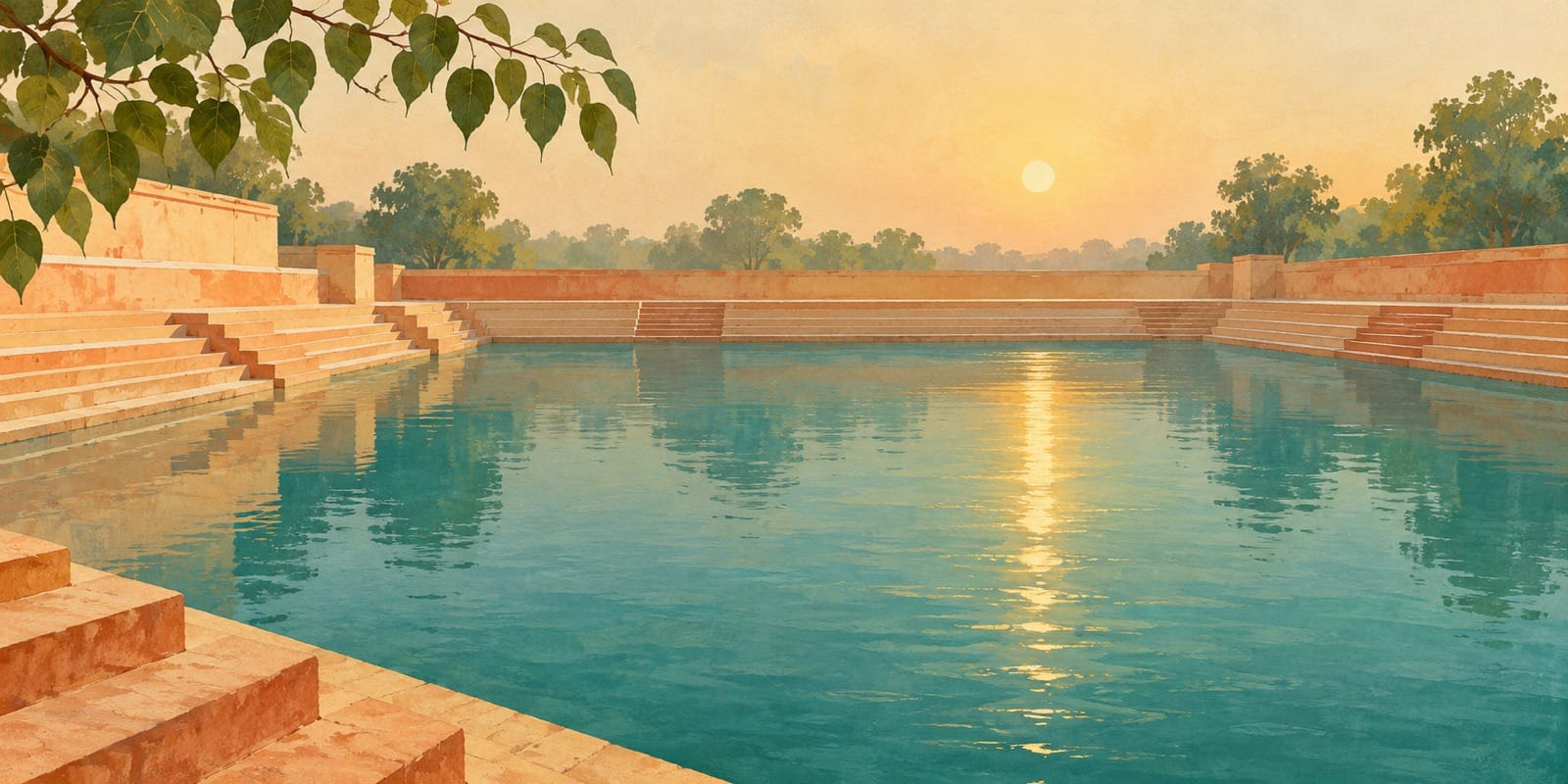
AI-generated editorial illustration inspired by stepped water tanks. Conceptual artwork, not a photograph or reconstruction of Surya Kund. Resized for display; full composition retained.