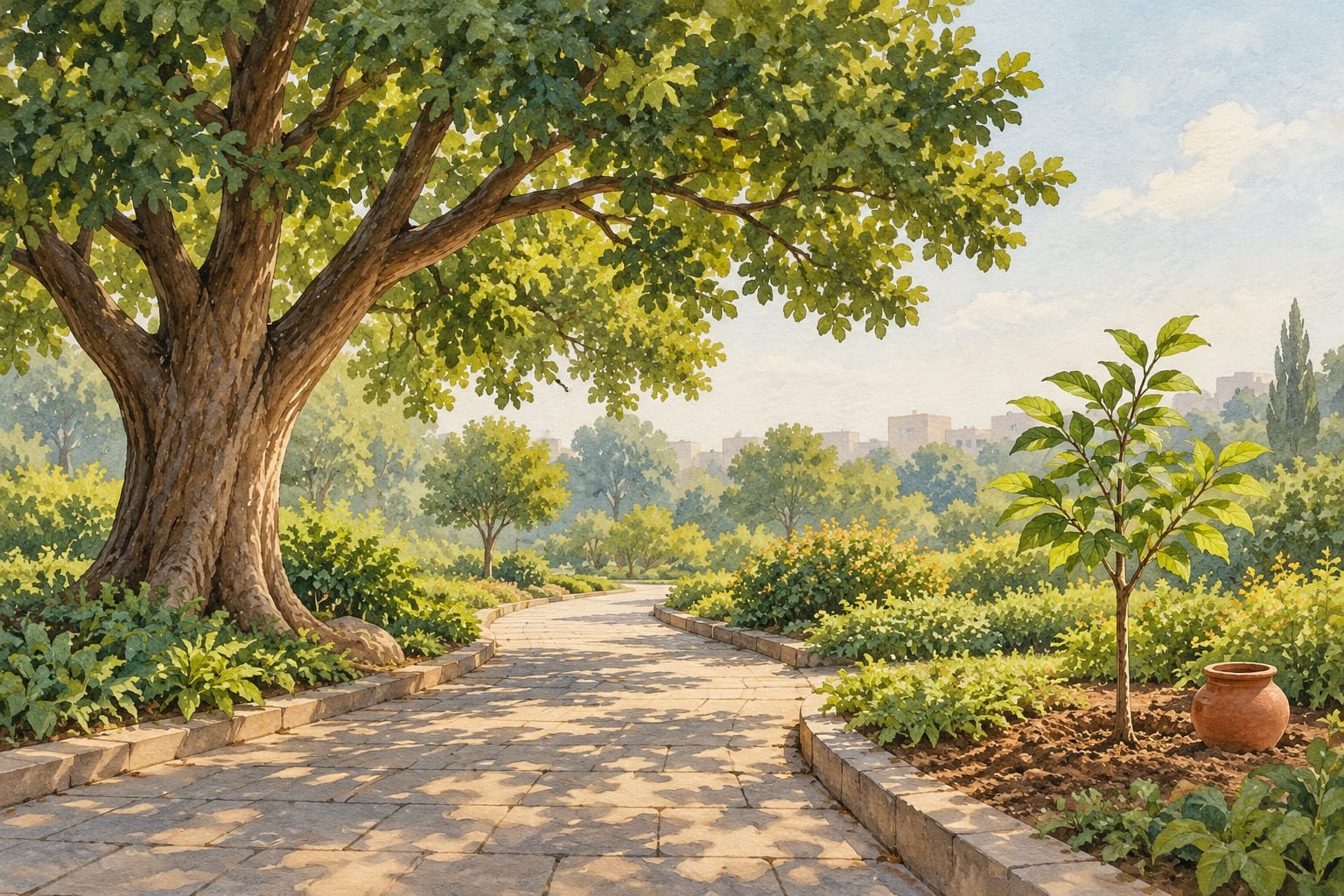
A young tree beside a path and the canopy above a resting place tell different parts of a city's green story. One asks you to imagine what might grow; the other already shapes the space around it. In Ayodhya, a documented planting project offers a starting point for looking beyond the day a sapling goes into the ground.
Grow-Trees reports planting 25,000 trees during financial year 2024–25 across the Guptar Ghat region, Lohiya Park and Company Garden. This is the operator's account of its own work, rather than an independently verified count of surviving trees today. Read the Ayodhya project record.
Start with the trees, not just the total
The project's species list includes arjun, jamun, kadamb, karanj, peepal and neem, among others. Those names make the proposal more tangible than a single planting number. They invite a closer look at the different trees a city chooses to grow.
If you are walking through a permitted public green space, choose one tree to notice. Look at the outline of its leaves, the shape of its branches and where its shadow falls. A photograph can help you return to the same detail later. Use a reliable identification resource before attaching a species name; the project's list does not identify every tree you encounter.
This is an observation exercise, not a report from an on-site visit. You do not need to collect leaves, leave the path or disturb a planted bed to enjoy it.
Planting day is only one stage
In its general methodology, Grow-Trees describes raising saplings in nurseries, choosing planting sites and involving local communities in planting. That account outlines its approach; it is not a substitute for a dated assessment of the Ayodhya trees. See the operator's methodology.
A useful follow-up question is simple: what happens after planting? The Food and Agriculture Organization of the United Nations treats urban forestry as a continuing process of planning, planting, maintenance, preservation and monitoring. Its guidance includes long-term care and protection, rather than ending the story with a new tree in the soil. Explore FAO's urban-forestry guidance.
For a reader following a local project, keep the planting date beside any later update. Ask what was checked, when it was checked and which part of the site it concerns. A planting total, a survival assessment and a photograph of a leafy canopy answer different questions. None should silently stand in for the others.
Notice the space a canopy makes
FAO's guidance also makes a case for retaining existing trees when urban areas develop: doing so can shorten the wait for the benefits of mature trees. New planting and care for established trees belong in the same conversation.
On your next walk, try looking at the path through its patches of light and shade. Where does the canopy reach? Does it cover the route, a place to pause, or only the planted ground? These are prompts for noticing how people and trees share space, not a survey of the city's canopy cover.
A sapling's presence does not establish that a route is shaded, accessible or comfortable on your visiting date. Check the actual arrangements for the place and people travelling with you. Follow local instructions and leave tree care to those responsible for the site.
Let green space become part of the visit
Ayodhya's buildings and stories may bring you to the city, but a few minutes noticing its trees can add another layer. Look again at the same branch or patch of shade when you return. The interest lies in a living place that changes, not simply in a completed planting tally.
For another way to look at the landscape around the city, read about the Saryu through a dolphin survey.
Sources checked on 24 October 2026. Project figures are attributed to the operator; current tree survival, site access and visitor facilities were not independently verified. This article does not solicit a donation or endorse a planting purchase.
AI-generated conceptual illustration of a mature tree and a sapling beside an imagined park path. Not a photograph of Ayodhya, an identified species or the reported planting project. Resized and JPEG-compressed for display.