Ravana does not have to look the same every time his story is performed. Three entries in the Indira Gandhi National Centre for the Arts' mask collection show different ways of shaping the character: a Purulia example built around a large central face, a Varanasi mask whose material list includes beads and zari, and a Dinajpur wooden example with additional heads fitted to the main one.
During the Dussehra season, it is easy to recognise the character before noticing the object. Looking at these records side by side changes the question. Alongside “who is this?”, ask what the maker has chosen to emphasise, which materials are named and how the faces are arranged.
Purulia: one face leads, the others recede
IGNCA's mask46 is catalogued as Ravana from Purulia, in the Purulia Chho group. The record credits the Sutradharas of Chorida as makers and lists clay, cloth, paper and colouring material.
Its description makes the arrangement unusually clear. The central head is the largest, with four smaller heads on one side and five on the other. The smaller faces diminish towards the outer edges. The catalogue also distinguishes the face from its crown and describes the dark-blue colour, prominent eyes and exposed teeth.
That gives the viewer a way to read the whole composition before examining its detail. Start at the centre, then follow the faces outwards. Repetition does not mean that every part has equal visual weight. The organisation of the heads is part of this object's character.
Varanasi: the maker is named
A different Ravana entry, mask294, is located by the catalogue in Varanasi and grouped under Ram Lila Masks. It names Shri Dashrath as maker and lists papier-mâché, beads and zari as materials.
The maker's name is worth keeping beside the character's name. “Ravana mask” identifies the role; the rest of the record begins to identify a particular made object. A material list also encourages a closer look at the relationship between the modelled form and the elements added to its surface.
This entry supplies less descriptive text than the Purulia record. It should not be made to tell us more than it does. The materials are documented; a complete workshop sequence, the object's creation date and the performance history of this particular mask are not established by that short entry.
Dinajpur: additional heads in fitted wooden pieces
Mask68 is catalogued as a Dinajpur Ravana in the Gamira group. The maker field credits Desi and Polia wood carvers, and the material field names wood and colouring material.
The description explains that nine additional heads are carved on two wooden pieces fitted to the main head through holes below the ears. It also notes the carved headgear, painted moustache and dark-orange body colour.
Here, the written record directs attention to a relationship between parts. Look for the main head and the added pieces as well as the expression on the face. This is a different construction description from the Purulia arrangement, and it belongs to the particular Dinajpur object in the record.
A mask and a voice need not work in one way
The relationship with performance becomes especially interesting in IGNCA and Sangeet Natak Akademi's 2010 Akhyan brochure. Its Ramnagar passage describes Ravana and his retinue wearing masks made with cloth over a solid base. It mentions eye openings without a mouth opening, with the actor lifting the mask while talking.
That passage cites a 1998 exhibition catalogue. It is a historical description of a particular practice, not a claim that every mask above works that way. Varanasi's catalogue entry and a general Ramnagar account cannot automatically be joined into a performance history for mask294.
Keeping that boundary makes the comparison more interesting. A mask's form, its materials and the way it is used are related questions, but they need their own evidence. The actor's gesture is not something a material label alone can establish.
Keep the place and the object together
Purulia Chho, the Varanasi Ram Lila group and Dinajpur Gamira should retain their separate names. These records offer three objects to compare, not three interchangeable definitions of a single regional tradition. Nor do they demonstrate which masks an Ayodhya production uses today.
The full 1998 catalogue was not examined for this article; the accessible object records and the later brochure are the sources used. Their catalogue numbers make the comparison traceable. They do not supply every object's date, acquisition history or current display arrangements.
For the wider performance context, our introduction to Ramlila in Ayodhya follows voices, scenes and participation. These three masks invite a narrower encounter: recognise the character, then give the maker's choices their own attention.
Primary collection records checked on 21 October 2026. This is a comparative reading of documented objects, not a workshop visit, making tutorial, current production guide or claim of universal regional practice.
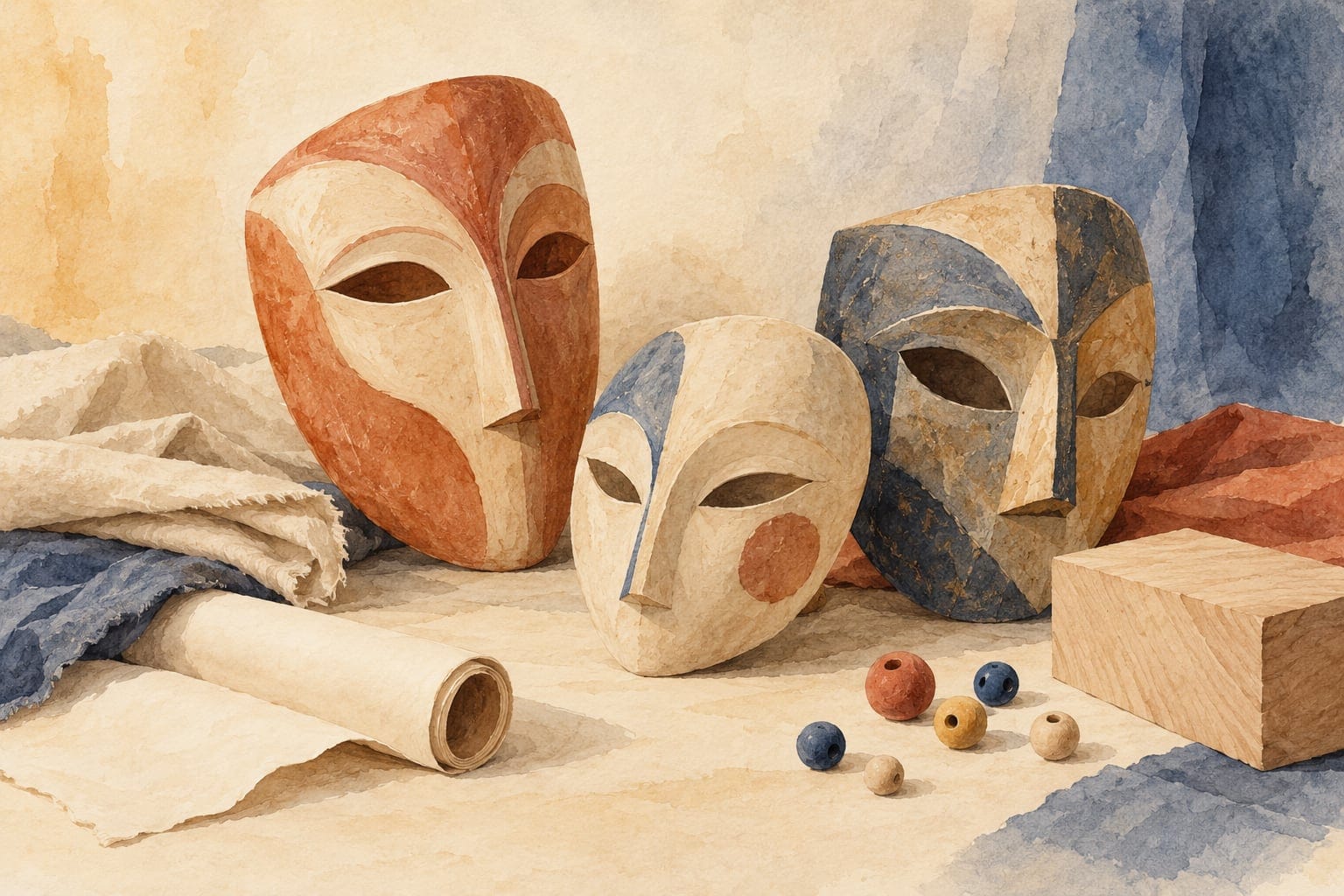
AI-generated conceptual illustration of generic theatre masks and materials. Not a photograph, tracing or reconstruction of the three IGNCA objects, a regional mask-making method or a real workshop. Resized for display.