Before opening a map of Ayodhya, ask the people coming with you what would make Dussehra feel meaningful. Someone may want a temple visit. Someone else may want to hear a familiar story with the grandchildren. A relative who has travelled overnight may want to join after resting.
A good family plan can make room for those answers. Choose one experience to anchor the outing, then arrange the day so people can enjoy it comfortably. The number of places reached is a poor substitute for being able to spend time together.
Choose the experience before the route
Begin with a reason to go: worship, a family memory, architecture, a performance or time near the Saryu. Ask which part matters most to each person. You may find one shared choice, or decide that a smaller group will make one visit while others meet them afterwards.
For place ideas and their cultural context, our Ayodhya guest-experience guide introduces Kanak Bhawan, Ram Ki Paidi and Hanuman Garhi. Treat them as possibilities to choose between, not a required circuit.
The Ministry of Tourism describes Hanuman Garhi as a hilltop temple approached by steep steps. The district administration identifies Ram Ki Paidi as a series of ghats on the Saryu. Those descriptions help identify different settings; neither establishes a suitable route or current facilities for a particular visitor.
Choose with the people who will make the journey. A riverfront should not be assumed step-free, and wanting to visit a temple does not mean everyone can manage the same approach. Let each person decide after hearing what the actual visit involves.
Give the pause a proper place
Plan the point at which the family will eat, sit down or return to its accommodation. Agree it before adding another destination. A pause works better when it has a real place in the plan than when it is something everyone hopes to fit in later.
Confirm the practical details with the property, site or organiser: the current drop-off point, the approach from it, stairs or uneven sections, seating, toilets and the return journey. Ask about assistive-device entry where relevant. These are questions to resolve for your visit, not facilities this article promises.
If you are hosting wedding guests, keep the information in the small group coordinating the outing. Ask privately what each guest wants checked, without asking them to explain personal health information in a large family chat. Our whole-route accessibility guide has the detailed method; the family plan should record the choice people make from those answers.
Make a quieter option part of the welcome
Some relatives will enjoy a lively gathering, while others would prefer a shorter or lower-smoke form of celebration. Offer that choice as an ordinary part of hosting. Staying back should not feel like failing the family outing.
The World Health Organization's air-pollution guidance identifies children, pregnant women, older people and people with existing cardiorespiratory conditions among groups at greater risk. It also explains that exposure varies with the place, time and activity. This is general guidance, not a report of today's air quality in Ayodhya.
If smoke is a concern, discuss a suitable alternative with the person affected and the organiser. Simply moving indoors does not guarantee cleaner air: WHO notes that indoor sources can include smoking, cooking and incense. Someone with a health condition should follow their own clinician's advice about their needs.
A shared meal afterwards, a conversation about the Ramayana or looking through the family's photographs can give people a way to take part without requiring everyone to attend the same gathering. Choose something they actually enjoy, rather than assigning them a substitute activity without asking.
Agree how the outing can change
For an organised performance or gathering, confirm the actual city, venue, date and visitor arrangements with its organiser. A production's name or an old poster cannot settle those details. Our Dussehra and Diwali guide explains the festival distinction without claiming a current local programme.
In its 2016 festival-crowd guidance, NDMA emphasised organisers' responsibilities for pedestrian routes, exits, traffic and emergency arrangements. Ask the current organiser where to find directions, help and the exit route. This older guidance does not verify what is in place at an event today.
Within the family, agree a meeting point, a reachable coordinator and how someone can leave earlier with a companion if they choose. Follow current staff directions. If conditions or a guest's needs change, allow the plan to change too.
Later, leave time to ask what people noticed. A remembered story, a detail on a building or an unhurried conversation may be the part they want to tell you about. Give that answer as much attention as the photograph of everyone arriving.
Primary sources checked on 20 October 2026. This is general family-planning guidance, not personalised medical advice. No current crowd level, air-quality reading, event time, access route or facility has been verified.
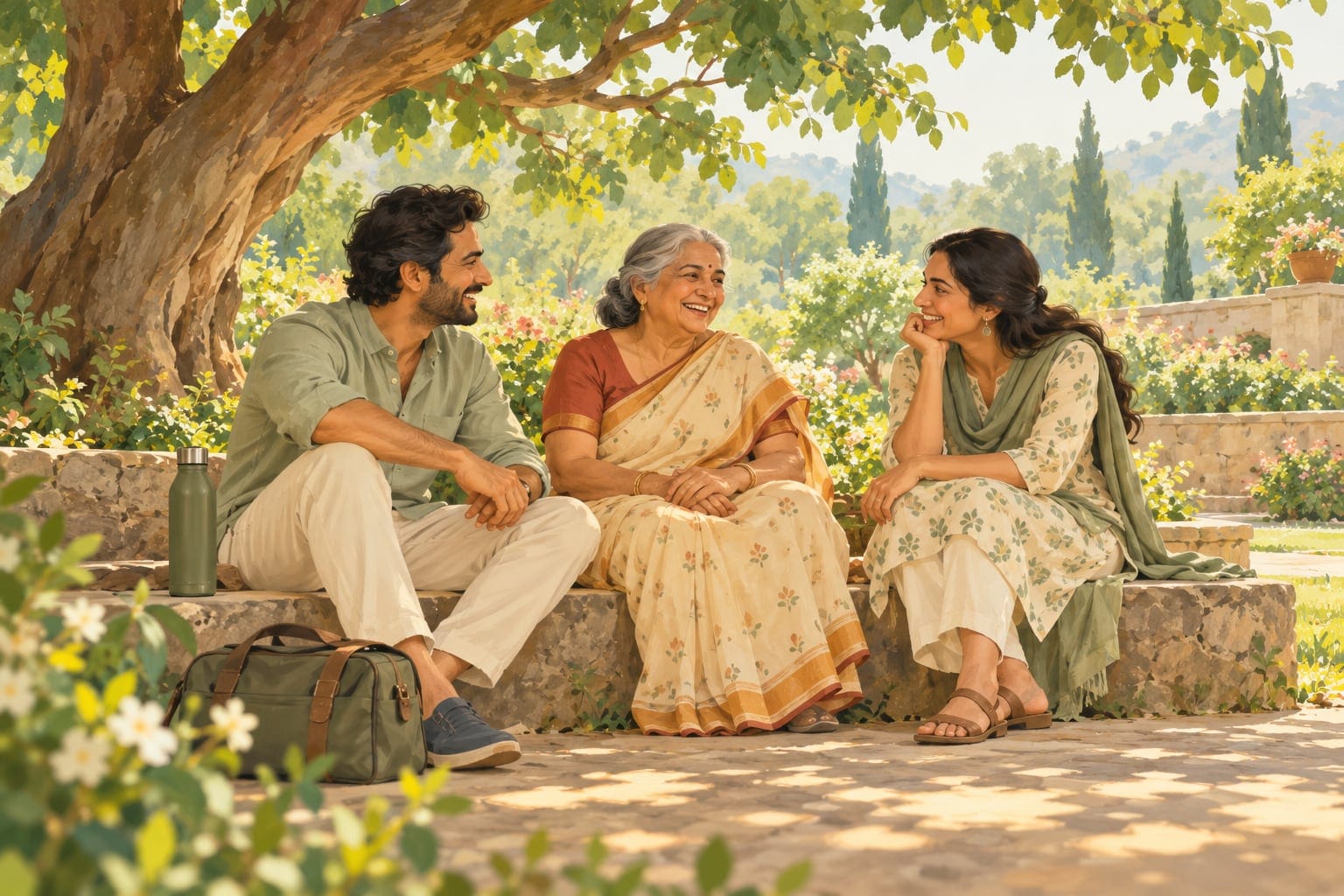
AI-generated conceptual illustration of a family resting in an imagined garden. Not a photograph of actual visitors, a verified Ayodhya rest area or an accessible facility. Resized for display.