A box of sweets can carry several messages: thank you for coming, we remembered you, take a little of the celebration home. Around Dussehra, and when relatives gather for a wedding in Ayodhya, it is worth deciding which message you want to send before choosing the box.
Prasad received through worship and mithai bought as a gift can both matter deeply to a family. Keep their purpose clear. Ask about the place of worship's current offering and distribution arrangements, and tell the recipient what you are sharing. A decorative package should not leave someone guessing about either its meaning or its contents.
Begin with the person receiving it
Think about the household rather than ordering the same large box for everyone. Will the sweets be opened at a family meal, carried on an overnight journey or given to someone living alone? A smaller portion handed over at the right time may be more welcome than a generous box with nowhere suitable to keep it.
Ask privately about ingredients people need to avoid and whether they want a food gift at all. Someone may appreciate joining the celebration without eating a sweet. A personal note, a shared story or another agreed gift can carry the welcome without putting them in the position of refusing at the table.
For the sweets themselves, our introduction to three Ayodhya sweets explores particular preparations and the makers described in published reporting. Here, the question is what happens after you choose: who receives the food, how it reaches them and what information travels with it.
Sacred meaning and careful handling belong together
Food shared through worship deserves the same attention to handling as food shared at home. FSSAI's Eat Right Places of Worship initiative encourages hygiene in preparing prasad and food, including training for food handlers and nearby vendors. Its BHOG guidance manual, first published in January 2018, addresses food safety and hygiene in places of worship.
Those resources show that respect for an offering and practical care for the person receiving it can sit together. They do not establish that a particular Ayodhya temple, stall or batch has been assessed or certified. Ask the people responsible about the actual arrangements rather than treating the word prasad as a substitute for that information.
If you hope to include an offering in a wedding welcome, clarify the religious arrangements first. Do not assume that a shop purchase has been offered in worship, or that visitor access includes permission for a private distribution or ceremony.
Ask about this batch, not a universal shelf life
Tell the maker when the gift will be eaten, how it will travel and whether the recipient can follow the recommended storage conditions. Ask which ingredients are used, the batch's best-before information and what the maker recommends once the package is opened. For an allergy, discuss ingredients and cross-contact directly; a general sweet name cannot answer those questions.
There is a useful historical distinction in FSSAI's order dated 25 September 2020. For non-packaged or loose sweets, it directed display of a best-before date on the container or tray from 1 October 2020, while making the manufacturing-date display voluntary. This is the wording of that dated order, not a complete statement of current labelling law.
For a host, the practical point is to ask for usable information about the sweets you are buying and pass it on. Do not apply one expiry estimate to every variety or assume a printed date makes unsuitable storage acceptable. If the maker's requirements cannot be met during the journey, choose a different gift or change when you hand it over.
Plan the handover as carefully as the purchase
Imagine relatives leaving after the final wedding function. One party goes straight home; another has a train the following evening. Giving both the same food at the same time may create different problems. Ask when they can realistically receive and store it, then arrange the handover around that answer.
Keep the maker's information with each separate package, especially when a large purchase is divided between households. Avoid leaving boxes in a reception area simply because it is convenient for the organiser. Agree who holds them, under what conditions and who gives them to the guests.
The World Health Organization's Five Keys to Safer Food include cleanliness, safe temperatures, and safe water and raw materials. These are general food-handling principles, not a shelf-life calculation for a particular mithai. Let them guide the questions you ask the supplier and the arrangements you can actually provide.
Leave room for the story
Alongside the practical information, add a few personal words: why you chose this sweet, whose favourite it is or what you hope the recipient remembers about the gathering. Attribute a maker's explanation rather than inventing a family tradition for the occasion.
Keep the gift separate from the meal-service plan; our wedding menu and service guide covers that wider task. A thoughtful send-off can be small: the right food for the person, a workable journey and a clear, warm handover.
Sources checked on 20 October 2026. This is original hospitality guidance; the 2020 order is identified historically. No local certification, universal shelf life or individual medical suitability is asserted.
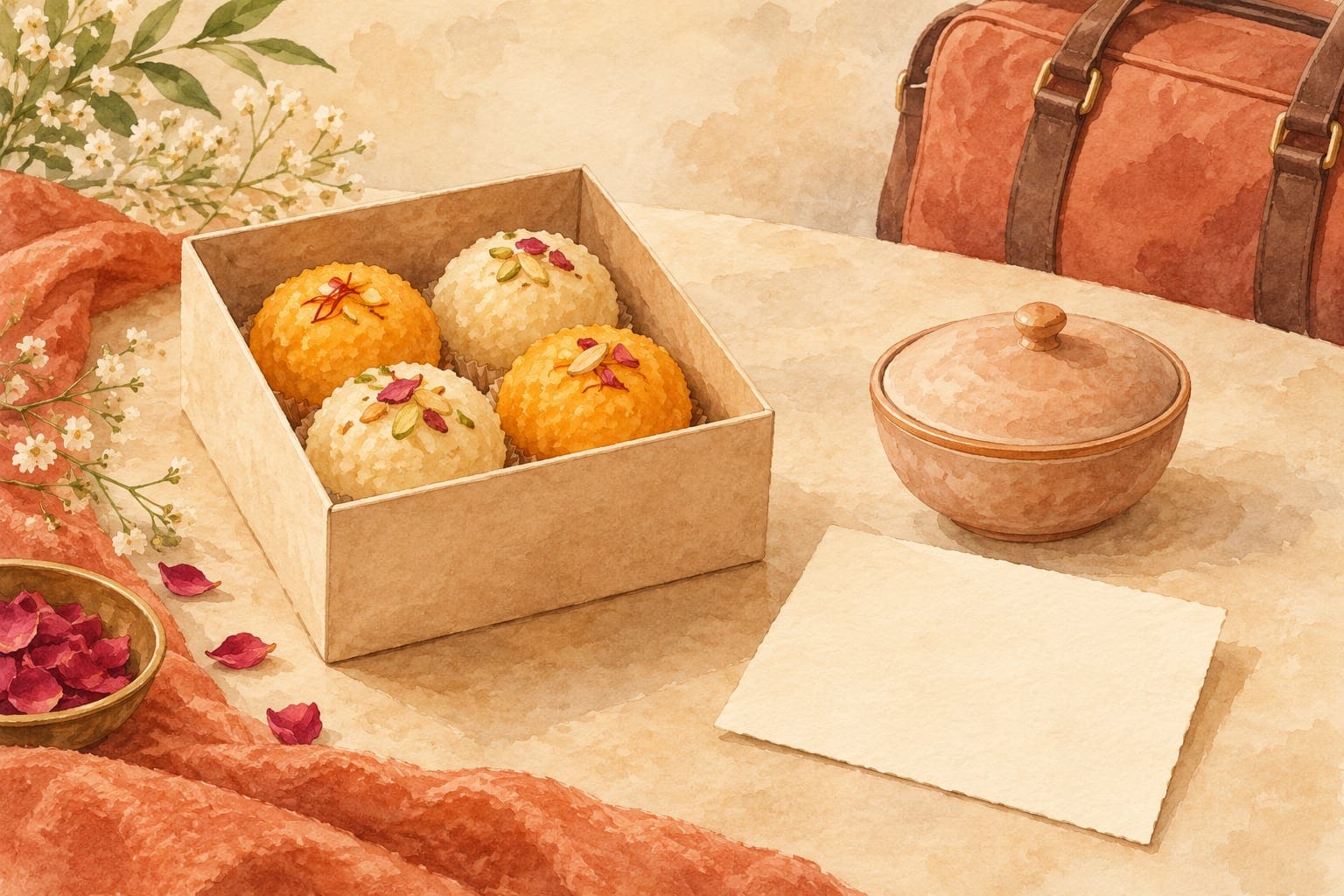
AI-generated conceptual illustration of sweets and a travel gift. Not a photograph of Ayodhya food, a temple offering, a verified recipe or certified packaging. Resized for display.