“What's your sign?” sounds like a small question. During a wedding-date conversation, it can open several different ones. Does someone mean a Sun sign, a Moon sign, a nakshatra or the rising sign in a birth chart?
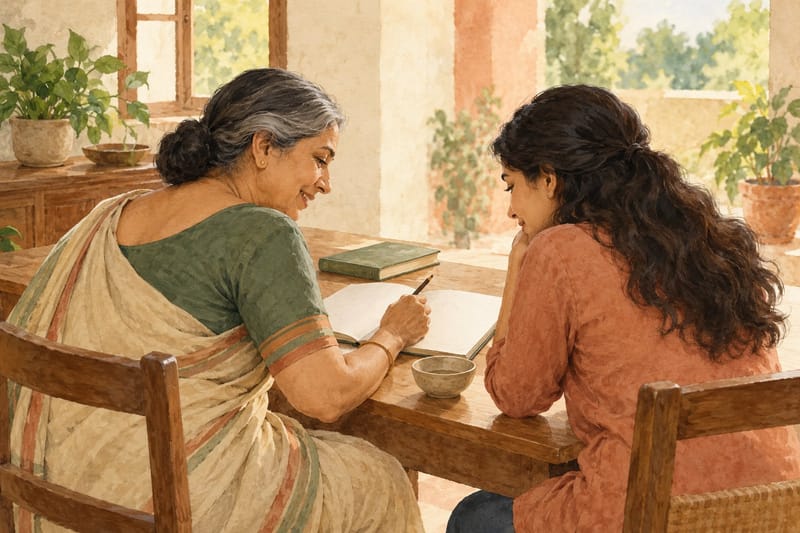
If Dussehra has prompted your family to discuss a new beginning, learning the words can make that discussion easier. You can understand a cultural vocabulary without using it to predict your relationship or requiring every relative to share the same beliefs.
Start by asking which sign someone means
In popular Western astrology, a “star sign” usually refers to a Sun sign. In an Indian family conversation, “rashi” may instead mean Janma Rashi, the Moon sign at birth. The two questions concern different references.
The astrological publisher Drik Panchang distinguishes these terms in its birth-chart resources. This short glossary follows that vocabulary; it is not a conversion chart between astrological systems.
- Surya Rashi: the Sun sign at birth.
- Janma Rashi: the Moon sign at birth; often shortened to “rashi” in that context.
- Janma Nakshatra: the nakshatra associated with the Moon's position at birth, commonly called the birth star.
- Lagna: the zodiac sign rising on the eastern horizon at birth, also called the ascendant or rising sign.
A familiar sign name is therefore not enough to establish which part of a chart someone is discussing. “Do you mean the Sun sign or the Moon sign?” is a friendly, useful question.
A nakshatra is another part of the vocabulary
Nakshatras are lunar divisions used in the Indian calendrical and astrological tradition. A Janma Nakshatra refers to the one associated with the Moon at a person's birth. It is not simply another name for their Sun sign.
You may encounter a birth-star name in a family record or hear it in a conversation with the person advising on a ceremony. Before comparing two records, ask what each entry represents and which system produced it. A clear label is more helpful than guessing from a name.
Birth details are personal information. Discuss what is actually needed and whom you want to share it with. A family celebration does not require posting a birth chart, precise birth time or other private details in a large group.
Calendar calculation and prediction are different claims
The India Meteorological Department's account of the Rashtriya Panchang describes calculations of tithis, nakshatras and celestial positions using modern astronomical methods. This is useful evidence about how calendar data is calculated.
It does not establish that a horoscope can predict a couple's happiness, health or prosperity. Astronomy measures and studies celestial objects; astrological interpretation assigns meanings to their positions. The two should not be treated as interchangeable.
NASA's January 2020 discussion of astrology explains the distinction and notes the lack of accuracy in astrological predictions under scientific investigation. You can respect the place a custom has in a family while being clear about the evidence for a claim.
What does this mean for a wedding date?
A person's birth-chart terms and the timing chosen for a future ceremony are related topics within astrology, but they are not the same entry in a calendar. A Sun-sign label alone is not a wedding muhurat.
If your family uses astrological selection, ask the person guiding it to explain the terms, the location being used and the particular ceremony time they are discussing. Families who do not use that approach can choose dates through their own priorities. Either approach still needs practical agreement about the venue and the people involved.
Our Dussehra wedding-planning conversation offers a gentle way to start with those shared priorities. For the festival's place in Ayodhya's story, read Dussehra and Diwali: victory and homecoming.
The most useful result may be a better question. Once people know which word they mean, there is more room to listen and less need to talk past one another.
Sources checked on 20 October 2026. This is a cultural terminology guide, not a horoscope, compatibility assessment or personalised marriage-date calculation.
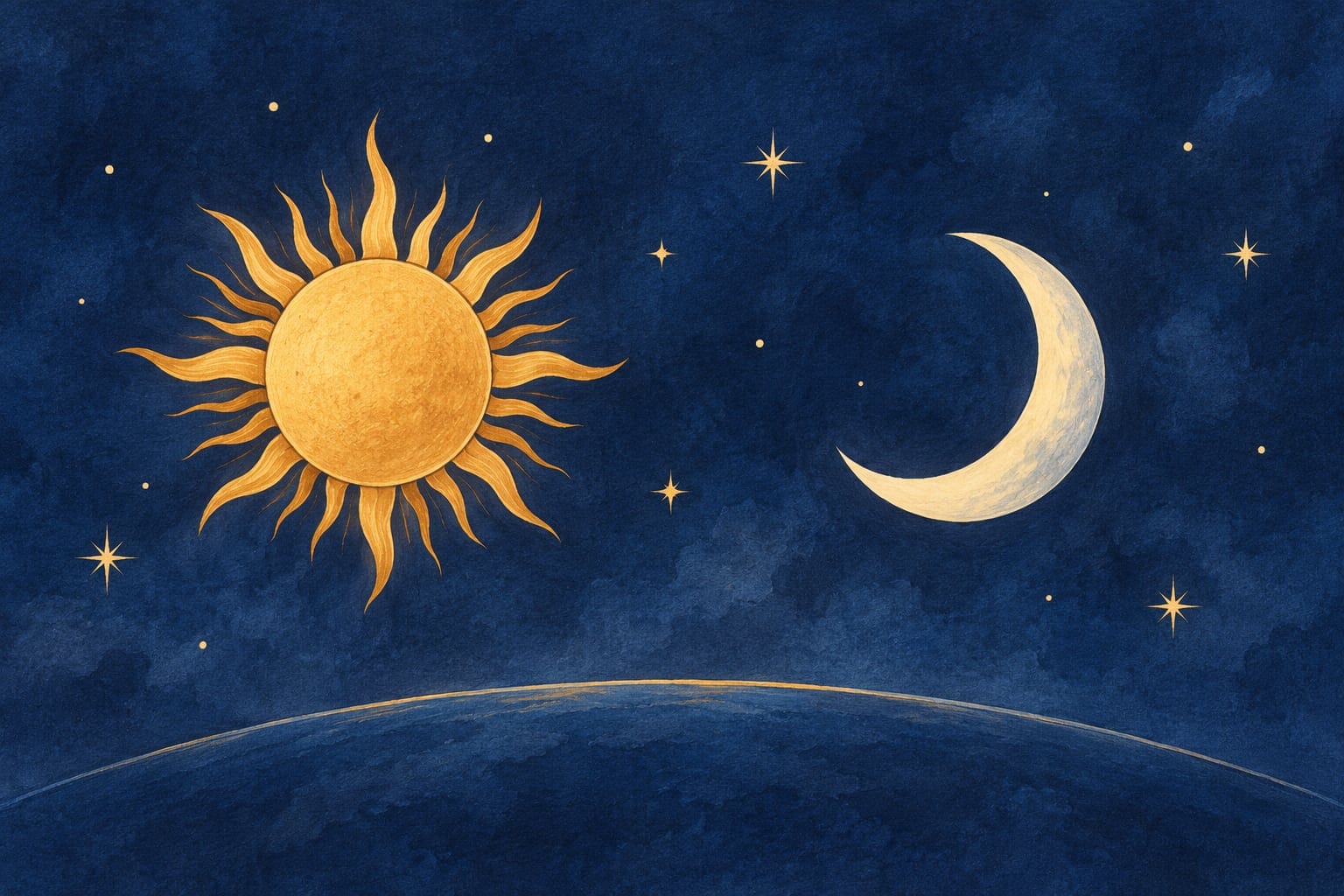
AI-generated conceptual illustration of the Sun, Moon and stars. Not an actual sky map, birth chart or prediction. Resized for display.